
Quick-Reference Summary:
- What are purlins? Horizontal beams (C or Z shaped) that support metal roof panels
- Common sizes: 4″, 6″, 8″, 10″, 12″ web heights
- Standard gauges: 12 ga, 14 ga, 16 ga
- Typical spacing: 2 ft to 5 ft on center (depends on panel gauge and load)
- Cost range: $2.00–$6.00+ per linear foot (2026 pricing)
- Finishes: Red oxide primer or galvanized
*Always consult a licensed structural engineer for your specific load requirements and local building codes.*
Table of Contents
What Are Metal Roof Purlins?
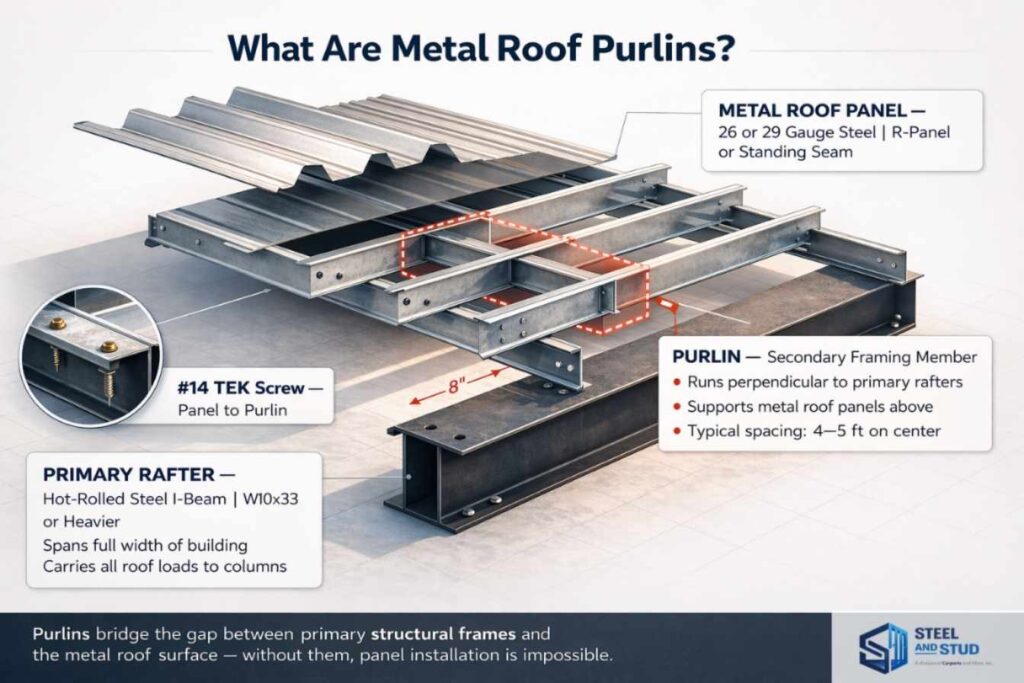
In structural engineering for metal building and construction of metal roofs, a purlin refers to a horizontal beam or bar used as structural support, mostly on roofs. Purlins get their support either from rafters or the walls of the building. The function of the purlin is to act as added support for the roof deck’s weight.
The metal roofing deck comprises a metal roof sheet, which is the metal roof’s surface. There are several types of purlins divided into categories based on what the metal roof requires — including the type of material and the shape. Different purlins offer different services including structural support for floors, walls, and the roof frame where roof sheeting rests.
Do You Need Purlins for a Metal Roof?
Yes — in most metal building applications, purlins are required. They serve as the critical connection between your primary frame (rafters or rigid frames) and the metal roof panels. Without purlins, roof panels have nothing to fasten to and no way to transfer wind, snow, and dead loads to the main structure.
However, there are a few exceptions:
- Solid roof decking: If you’re installing metal roofing over plywood or OSB sheathing (common in residential re-roofing), the decking replaces the need for purlins.
- Structural insulated panels (SIPs): These panels span between rafters without separate purlins.
- Direct-to-rafter attachment: Some corrugated panels can attach directly to closely spaced rafters (16″–24″ on center), but this is less common in metal building construction.
For virtually all pre-engineered metal buildings, steel purlins are a non-negotiable part of the framing system.
Can You Install Metal Roofing Directly on Purlins?
Yes, you can install metal roofing directly on purlins — and this is the standard method in most steel building construction. The metal roof panels fasten through their ribs directly into the purlins below using self-drilling screws.
When direct-to-purlin installation works well:
- Commercial, agricultural, and industrial metal buildings
- Carports, 20×40 metal garages, and open-frame structures
- Buildings where vapor barriers are applied over the purlins before panel installation
When you might need additional layers:
- In conditioned (heated/cooled) buildings, you’ll want insulation between purlins and panels
- In high-humidity environments, a vapor barrier prevents condensation
- For re-roofing over existing metal, a sub-purlin system may be needed
The key is ensuring your purlin spacing matches the requirements of your specific metal panel gauge and profile.
Purlins as Secondary Framing in Metal Buildings
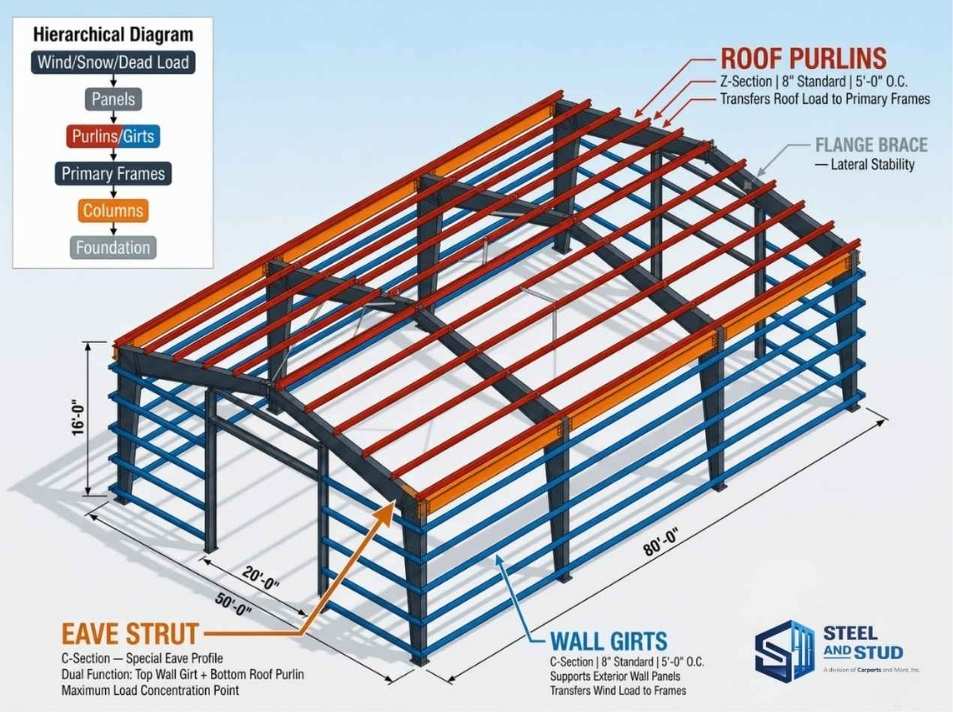
Purlin and girt are components that make up the secondary framing. Secondary framing is a fundamental component of a number of pre-engineered metal buildings, also known as “secondary structural.”
Secondary framing distributes the weight from the surfaces of the building through to the main framing and, ultimately, to the foundation. It is also fundamental in adding longitudinal support, which is essential in resisting earthquakes and winds.
Roof framing members, which are part of the secondary framing, support the roof as reinforcements. They are created into a horizontal “diaphragm” upon which the weight of the building’s roof deck rests. They also make the entire roof structure firm.
Since purlins add mid-span support, they allow long spans that enable you to come up with a wider building.
For example, a 40×60 metal building typically requires 8-inch or larger purlins to handle the 60-foot bay spans, while a smaller 20×30 metal building may only need 6-inch purlins.
Eave struts are another type of secondary framing, also referred to as eave purlins. The eave purlins are fundamentally a combination of the two purlins. They are used in places where the sidewalls intersect with the roof, with the help of a flange that aids in support of the roof and a “web” that supports the walls.
Secondary framing can be achieved in two configurations: CEE and ZED. The shape is achieved using the bending press, which creates a web with two flanges. Secondary framing comes in various sizes — purlins, for instance, can be any length up to 30 feet long.
Types of Purlins for Metal Roofs
C Purlins (Cee Purlins)
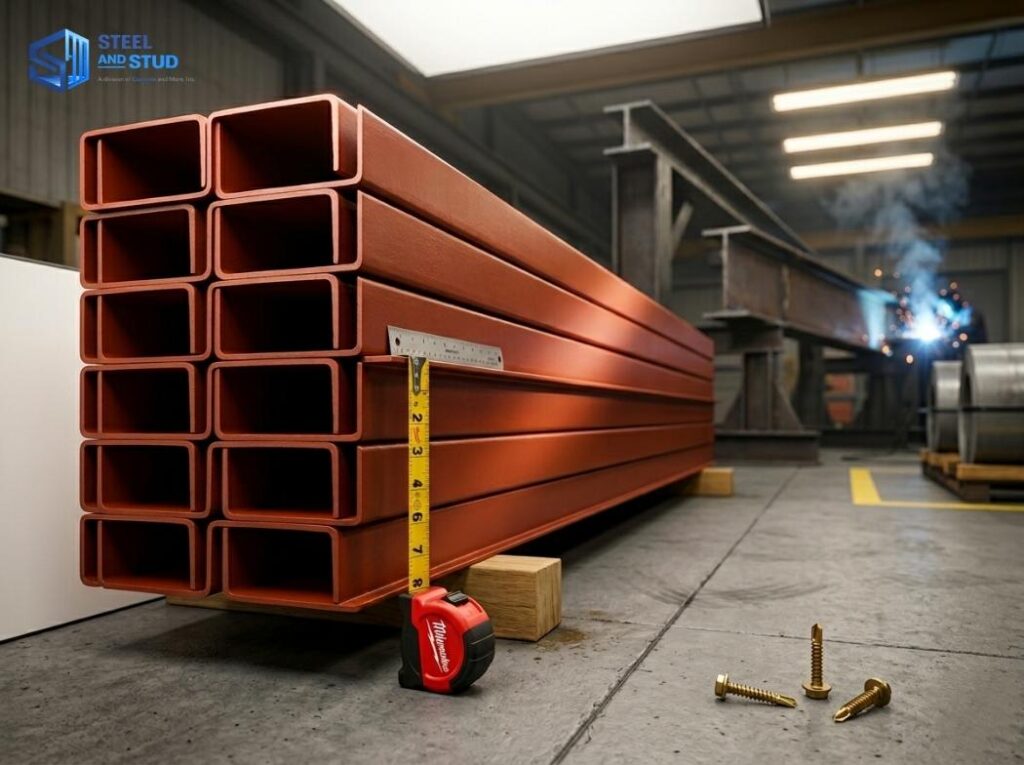
C purlins are formed in the shape of the letter C. Their primary use is to support floors, walls, and roof structures. C-section purlins, also referred to as cee section purlins, are made to shape the shell structure of the walls and the floor joists, which makes them suitable to support flooring beams.
C-section purlins from our stores are made with an extension on their ends, which means they can be used in single spans. The purlins are free-standing, making them secure and easily manageable during mounting. We offer a wide range of thicknesses.
C purlin key specs:
- Best for single-span applications
- Available in 4″ to 12″ web heights
- Common gauges: 12, 14, and 16 gauge
- A 6-inch C purlin can typically span 15–20 feet (simple span, light loads — always verify with engineering)
- An 8-inch C purlin can span 20–25 feet under similar conditions
*Note: Actual span capacity depends on gauge, load conditions, and local building codes per AISI S100 cold-formed steel design standards.*
Z Purlins (Zed Purlins)
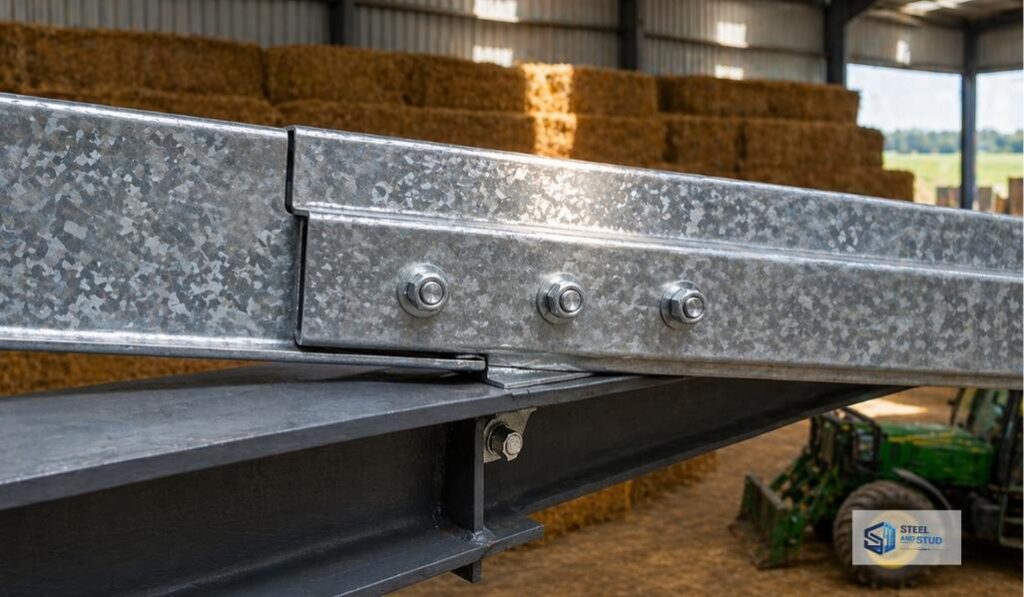
Another type of purlin is the Z purlin, which is stronger than the C purlin at overlaps and joints in most cases. Zed purlins are beams horizontally built to shape a metal structure’s wall joists and roof.
The zed-shaped purlins sit between the building and the roofing sheets. Therefore, the purlins act as sheet support, ensuring that the sheets are attached firmly and securely into their place.
Due to the unique capabilities of the zed purlins — lightweight and flexible — they are commonly used in industrial and agricultural buildings.
Their overlapping design at supports makes them ideal for continuous multi-span applications, which increases load-carrying capacity compared to single-span C purlins.
We manufacture standard zed purlins and customized ones. We also manufacture the purlins in either un-drilled or pre-drilled holes, either oval shapes or round shapes. Web height can be achieved at varying dimensions up to 300mm, and a thickness of 3.2 mm is also achievable.
Sigma Purlins
These are C-shaped purlins but with special ribs, which are referred to as “SIGMA” purlins. The SIGMA purlins have good structural properties. These purlins are manufactured and installed to shape the shell structure of the building and its walls and floor joists. This nature of the purlins makes them ideal also for supporting beams that are essential in flooring.
The ribbed profile of sigma purlins gives them higher resistance to web crippling and lateral-torsional buckling compared to standard C purlins of the same size. They’re most commonly found in European construction but are gaining traction in U.S. commercial metal building projects.
C Purlin vs Z Purlin: Which Should You Choose?
Choosing between C and Z purlins depends on your building design, span requirements, and budget. Here’s a side-by-side comparison:
Feature | C Purlin | Z Purlin |
Shape | Channel (C) | Z-shaped |
Best for | Single spans, walls | Continuous/multi-spans, roofs |
Overlap capability | No (butt joints only) | Yes (nesting at supports) |
Ease of installation | Easier — free-standing | Slightly more complex |
Load capacity | Good for moderate spans | Higher for continuous spans |
Cost | Slightly lower | Slightly higher |
Common use | Small buildings, 20×20 metal buildings, carports | Large commercial, agricultural, 50×100 metal buildings |
Rule of thumb: If your building has simple, single-span bays, C purlins work well. If you have continuous multi-bay framing or longer spans, Z purlins give you better structural performance thanks to their overlapping capability.
Wood Purlins vs Steel Purlins for Metal Roofs
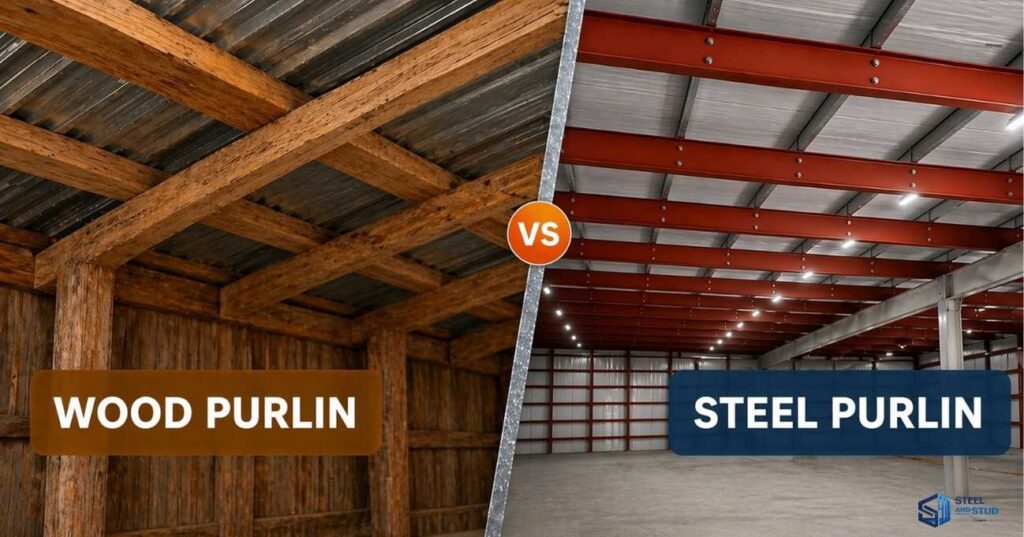
Many DIYers and residential builders ask about using wood purlins for metal roofs — typically 2×4 or 2×6 lumber. Here’s how they compare to steel C/Z purlins:
Feature | Wood Purlins (2×4/2×6) | Steel Purlins (C/Z) |
Cost | Lower upfront | Higher upfront, lower long-term |
Span capability | Limited (8–12 ft for 2×6) | Up to 30 ft |
Fire resistance | Combustible | Non-combustible |
Pest/rot resistance | Vulnerable | Immune |
Dimensional stability | Warps, twists over time | Stays straight |
Weight | Heavier per span | Lighter |
Best for | Small sheds, residential re-roofs, pole barns | Metal buildings, commercial, agricultural |
Wood purlins are a viable option for small residential projects and pole barns. For any pre-engineered metal building, steel purlins are the standard and recommended choice.
Metal Purlin Sizes: What Size Purlins Do You Need?
Purlins are manufactured in standard sizes of the nominal length of:
- 100mm (4 inches)
- 150mm (6 inches)
- 200mm (8 inches)
- 250mm (10 inches)
- 300mm (12 inches)
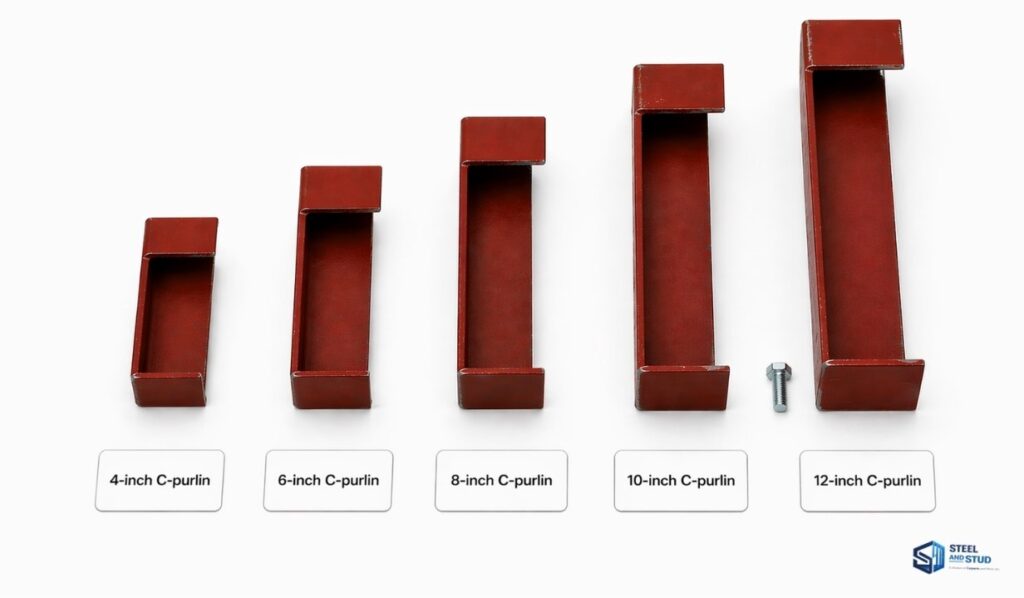
Standard Purlin Dimensions (4" to 12")
Nominal Size | Web Height | Typical Flange Width | Common Gauges |
4″ | 4.000″ (100mm) | 1.625″–2.000″ | 14 ga, 16 ga |
6″ | 6.000″ (150mm) | 1.625″–2.500″ | 12 ga, 14 ga, 16 ga |
8″ | 8.000″ (200mm) | 2.500″–3.000″ | 12 ga, 14 ga, 16 ga |
10″ | 10.000″ (250mm) | 2.500″–3.500″ | 12 ga, 14 ga |
12″ | 12.000″ (300mm) | 3.000″–3.500″ | 12 ga, 14 ga |
The right size depends on your span distance, load requirements (snow load, wind load, dead load, live load), and purlin spacing. Larger buildings like a 100×200 metal building will typically require 10″ or 12″ purlins, while a 12×20 metal building may only need 4″ or 6″ purlins.
C Purlin Span Tables (6" and 8" Spans)
These are general span guidelines for simple-span C purlins under moderate loading. Always consult a licensed structural engineer for your specific project.
Purlin Size | Gauge | Approximate Simple Span (Moderate Load) |
6″ C Purlin | 16 ga | 12–15 ft |
6″ C Purlin | 14 ga | 15–20 ft |
6″ C Purlin | 12 ga | 18–22 ft |
8″ C Purlin | 16 ga | 18–22 ft |
8″ C Purlin | 14 ga | 20–25 ft |
8″ C Purlin | 12 ga | 22–28 ft |
*Spans assume standard roof dead load (~3 PSF) and moderate live/snow load (~20 PSF). Actual capacity varies with tributary width, bracing, and continuous vs. simple span configuration per AISI S100.*
Metal Purlin Gauges Explained
The gauges for metal roof purlins are 12 gauge, 14 gauge, and 16 gauge. To determine the exact gauge for your building, consult an engineer. Our technical personnel can also determine the best gauge to fit your building.
How Thick Should Purlins Be for a Metal Roof?
Purlin “thickness” refers to the steel gauge. Here’s what each gauge translates to:
Gauge | Thickness (inches) | Thickness (mm) | Best For |
16 gauge | 0.0598″ | 1.52mm | Light-duty: small carports, sheds, 12×24 metal buildings |
14 gauge | 0.0747″ | 1.90mm | Standard: most residential and commercial metal buildings |
12 gauge | 0.1046″ | 2.66mm | Heavy-duty: high snow/wind loads, wide spans, 80×100 metal buildings |
The heavier the gauge (lower number = thicker steel), the greater the load-bearing capacity. For most standard metal buildings, 14 gauge is the go-to choice. Buildings in areas with heavy snow loads (like metal buildings in Minnesota or Alaska) often require 12 gauge purlins.
Purlin Spacing for Metal Roofs
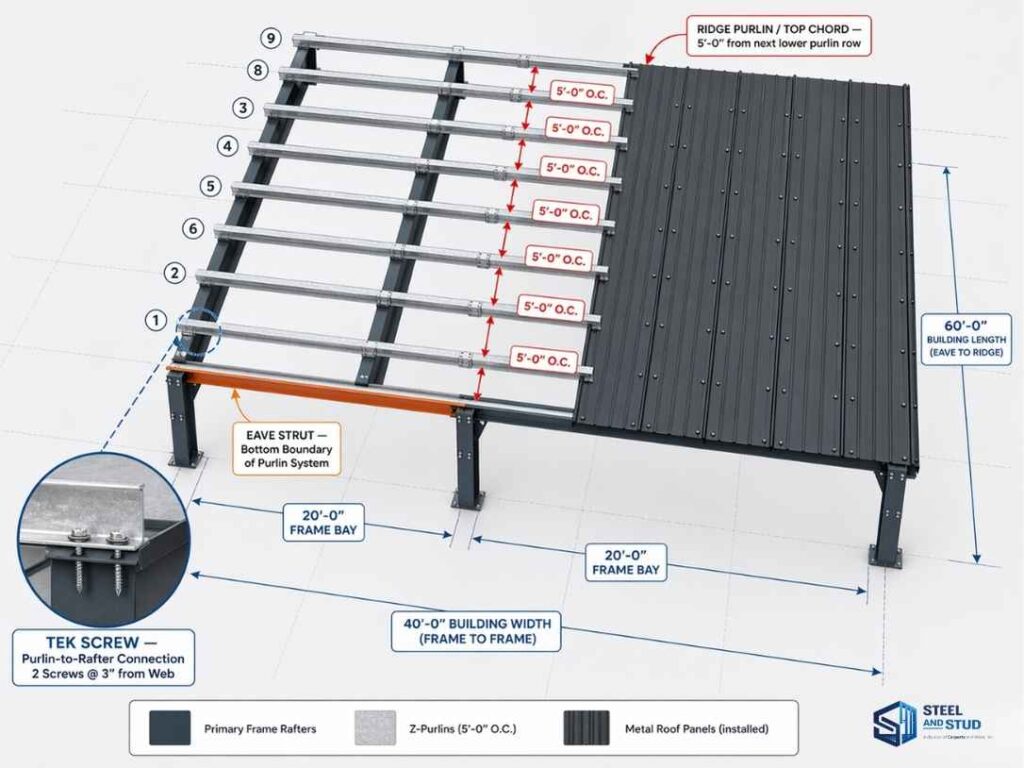
The ideal spacing of purlins is determined by the weight that the structure will carry and the load that is to be carried by the metal panels. The heavier the expected load, the shorter the distance between the purlins.
The spacing of the purlins will determine the number of metal purlins needed for the job. The shorter the spacing between purlins, the more purlins you need. More purlins account for increased cost of materials.
General Purlin Spacing Guidelines (2 ft to 5 ft)
For most metal roofing applications, purlin spacing falls between 2 feet and 5 feet on center. The standard default for many metal buildings is 24 inches (2 feet) on center, but this can be wider depending on:
- Panel gauge: Thicker panels (26 gauge) can handle wider spacing than thinner panels (29 gauge)
- Snow load: Heavy snow regions require closer spacing
- Wind load: High-wind areas (coastal regions, metal buildings in Hawaii) need tighter spacing
- Roof pitch: Steeper roofs shed loads faster, allowing slightly wider spacing
- Panel profile: Ribbed panels (like R-panel) are stiffer than flat panels and can span farther
Purlin Spacing for 26 Gauge Metal Roofing
26 gauge metal roofing is the most common panel thickness for commercial and agricultural metal buildings. Recommended purlin spacing:
- Standard conditions: 4 ft to 5 ft on center
- Moderate snow/wind loads: 3 ft to 4 ft on center
- Heavy snow/wind loads: 2 ft to 3 ft on center
26 gauge panels are strong enough to span wider purlin distances, which means fewer purlins and lower material costs for your project.
Purlin Spacing for 29 Gauge Metal Roofing
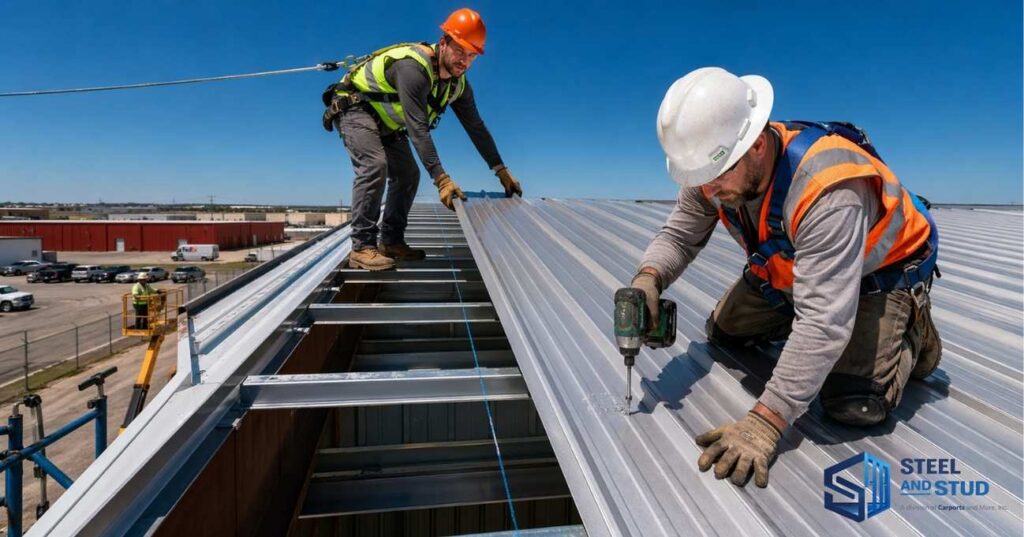
29 gauge metal roofing is thinner and more flexible than 26 gauge. It requires closer purlin spacing to prevent oil-canning, sagging, and wind damage:
- Standard conditions: 2 ft to 3 ft on center
- Moderate snow/wind loads: 2 ft on center
- Heavy loads: Not recommended — upgrade to 26 gauge
29 gauge panels are best suited for residential, carport, and light-duty applications. If you’re building in a region with significant snow or wind, consider upgrading to 26 gauge panels to allow wider spacing and reduce purlin count.
2x4 Purlin Spacing for Metal Roof
When using 2×4 wood purlins for a metal roof (common in pole barns and residential projects):
- Typical spacing: 24 inches on center
- Maximum recommended: 36 inches on center (light loads only)
- Rafter spacing matters: If rafters are 4 ft apart, 2×4 purlins at 24″ OC work well. If rafters are wider, upgrade to 2×6.
2×4 purlins are limited in span — they should not span more than 3–4 feet between supports (rafters). For wider rafter spacing, use 2×6 or switch to steel purlins.
1x4 Purlin Spacing for Metal Roof
1×4 purlins (¾” x 3½” actual) are only appropriate for very light-duty applications:
- Maximum spacing: 16–24 inches on center
- Maximum span between rafters: 2 feet
- Best for: Small sheds, lean-tos, and temporary structures
1×4 lumber has very limited load capacity. For anything beyond a small garden shed, upgrade to 2×4 minimum or steel purlins.
Rafter and Purlin Spacing Relationship
Rafter spacing and purlin spacing work together. Here’s how they interact:
- Closer rafter spacing (4 ft OC): Purlins can be lighter (smaller gauge or wood 2×4) because they span a shorter distance
- Wider rafter spacing (8–10 ft OC): Purlins must be heavier (larger steel C/Z purlins) to handle the longer unsupported span
- Standard metal building rafter spacing: 20–25 feet between rigid frames, with steel purlins spanning the distance
For a 30×40 metal building with frames at 20-foot bays, you’d typically use 8″ C or Z purlins at 5 ft on center. For a 50×80 metal building with 25-foot bays, 10″ purlins may be required.
Red Oxide vs. Galvanized Metal Purlins
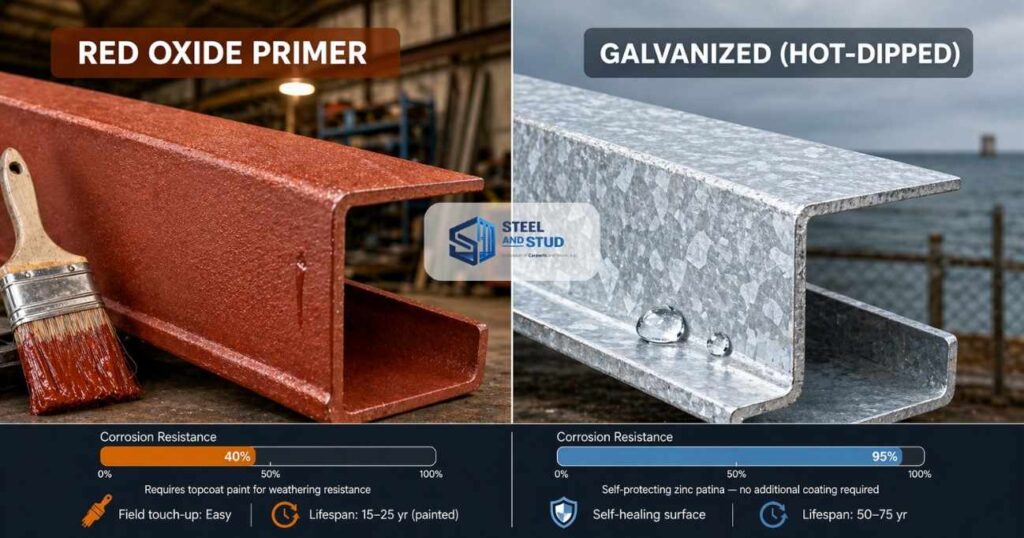
Red oxide is a water-based paint that is safe for the environment. Once the red oxide paint has been applied to all the components of the structural steel, surface corrosion is inhibited. Red oxide is durable — it can withstand loading and unloading abuse as well as field handling when being erected. The method also allows you to paint the building different colors as you wish.
Galvanized metal is sometimes recommended when the environment has a potential corrosive effect, like salt water. However, galvanized steel is extremely abrasive; hence, it must always be handled with extreme care with gloves. When exposed to moisture, galvanized steel is not fully resistant to oxidation. This type of steel can produce unsightly rust over time.
Generally, red oxide primer is considered a better material than galvanized steel for most applications.
Feature | Red Oxide Primer | Galvanized (Hot-Dipped) |
Cost | Lower | Higher |
Corrosion protection | Good (interior/covered) | Better (exterior/exposed) |
Paintability | Easily painted any color | Requires special primer first |
Handling | Standard gloves | Must use gloves — abrasive coating |
Best environment | Enclosed buildings, dry climates | Coastal, humid, or corrosive environments |
Standard | Common default | Specify per ASTM A653 for coating weight |
Our recommendation: Use red oxide for enclosed metal buildings in dry to moderate climates. Choose galvanized for buildings in coastal areas (like metal buildings in Louisiana or Connecticut) or anywhere purlins will be exposed to moisture long-term.
Cost of Metal Purlins in 2026
The pricing of metal purlins depends on the job size, size of the purlin, and steel thickness.
Metal Purlin Pricing Chart by Size and Finish
*Prices reflect 2026 market conditions and may vary by region, steel market fluctuations, and order volume.*
Purlin Size | 14 Gauge, Galvanized | 14 Gauge, Red Oxide |
4″ (100mm) | $2.00–$3.00 per linear ft | $2.00–$2.50 per linear ft |
6″ (150mm) | $3.00–$4.00 per linear ft | $2.50–$3.00 per linear ft |
8″ (200mm) | $4.00–$5.00 per linear ft | $3.50–$4.00 per linear ft |
10″ (250mm) | $4.50–$5.50 per linear ft | $4.00–$5.00 per linear ft |
12″ (300mm) | $5.00–$6.00 per linear ft | $4.50–$5.50 per linear ft |
Factors That Affect Purlin Cost
- Job size: Larger orders (e.g., for a 100×100 metal building) typically qualify for volume discounts
- Steel market prices: Raw steel costs fluctuate — get a current quote for accurate pricing
- Gauge: 12 gauge costs more than 14 or 16 gauge due to more material
- Finish: Galvanized costs 15–30% more than red oxide
- Custom lengths: Non-standard lengths may carry a cutting fee
- Delivery: Shipping long purlins requires flatbed trucks; distance affects cost
For a quick estimate, a typical 30×50 metal building might need 20–30 purlins at 8″ size, costing roughly $2,000–$3,500 for purlins alone (materials only).
Metal Purlins for Your Roof
Roofing is among the final steps in your building project. This means that you should ensure that you have put in place the best materials to give you a good final touch to your metal building.
Metal purlins are essential for the stability and protection of your metal roof. Installation of the correct purlins placed with the right spacing will provide your roof with an extra level of protection.
Purlins also contribute to energy efficiency in metal buildings. By creating an air gap between the roof panels and the insulation layer, purlins allow for proper ventilation and thermal break, which reduces heat transfer and can lower energy costs. This is especially important in conditioned buildings like metal building homes or climate-controlled workshops.
The following is a chart of summarized features of the metal purlins:
Feature | Options |
Types | C Purlins, Z Purlins, Sigma Purlins |
Gauges | 12 ga, 14 ga, 16 ga |
Finishes | Red Oxide, Galvanized |
Sizes | 4″, 6″, 8″, 10″, 12″ |
How to Install Metal Roof Purlins (Step-by-Step)
Tools and Materials Needed
- Steel purlins (C or Z, sized per engineering)
- Self-drilling TEK screws or structural bolts
- Purlin clips (if required by design)
- Tape measure and chalk line
- Drill/impact driver
- Level
- Safety harness and fall protection
- Ladder or scaffolding
- Tin snips or cold saw (for cutting to length)
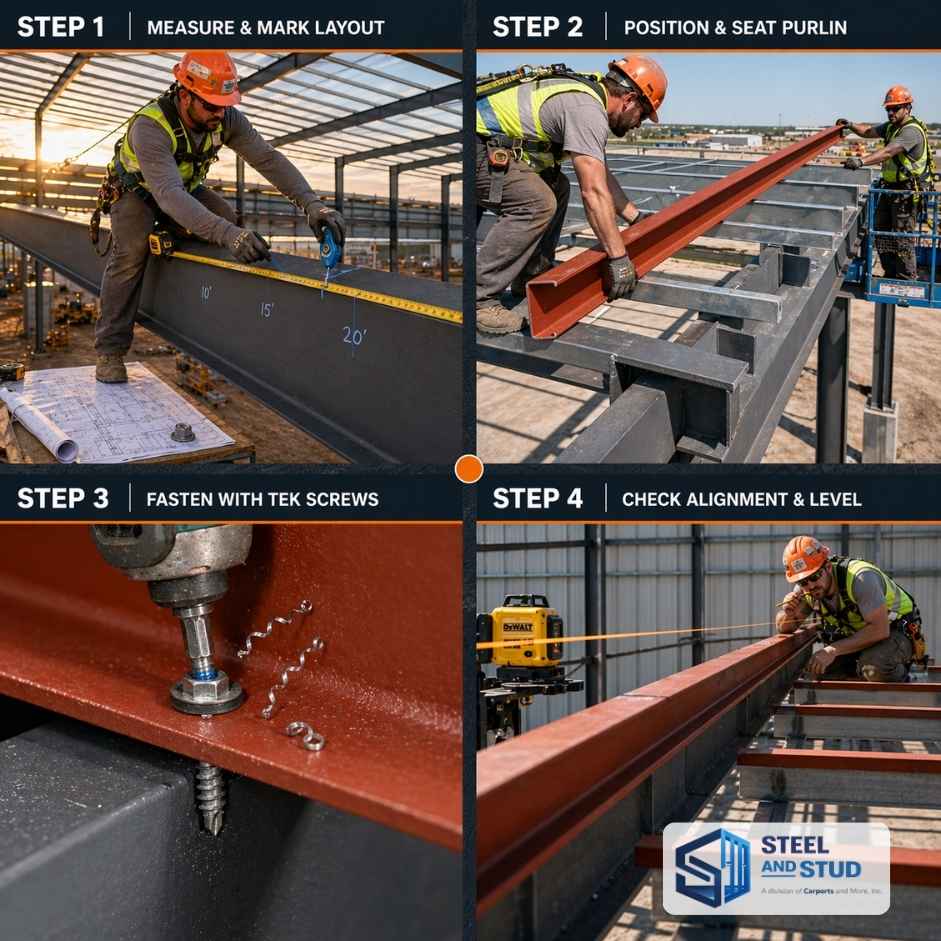
Step-by-Step Purlin Installation
Purlins are installed horizontally. They are to be installed strategically on top of the roof rafters.
Step 1: Determine the number of purlins needed. This is achieved by taking measurements of the roof and dividing by your required spacing (on center).
Step 2: Snap a chalk line across the roof horizontally, starting two feet from the ridge. Lay the first purlin at the roof ridge beginning at either corner. Fasten the purlin with appropriate fasteners (TEK screws for steel rafters, 16d nails for wood rafters) into the vertical rafters.
Step 3: Place the second purlin right next to the first one, also horizontally, and install it with the same fasteners into the rafters. Continue this until you finish the first row, then cut to size the last purlin if necessary.
Step 4: Move down the roof to the next chalk line (based on your required spacing) and snap another horizontal chalk line. From this, install another row of purlins, similar to the first one. Continue this until the roof is covered with purlins.
Step 5: Inspect the area and ensure that all fasteners are well driven and that all purlins are secured into the roof rafters.
Check alignment with a string line across each row to ensure purlins are straight — misaligned purlins cause wavy roof panels.
Common Purlin Installation Mistakes to Avoid
- Incorrect spacing: Even small spacing errors compound across the roof and cause panel alignment issues. Measure twice.
- Wrong gauge or size: Using undersized purlins to save money can lead to structural failure under load. Follow engineering specs.
- Missing anti-roll clips: Z purlins can roll under load if not properly braced with anti-roll clips at supports.
- Over-tightening fasteners: Stripping TEK screws weakens the connection. Use proper torque settings.
- Ignoring sag rods: On longer spans, sag rods or bracing between purlins prevent lateral movement and twisting.
- Not accounting for thermal expansion: Steel purlins expand and contract with temperature changes. Allow for movement at connections on long runs.
Purlin Maintenance and Inspection Tips
Once installed, metal purlins require minimal but important maintenance to ensure long-term structural integrity:
- Annual visual inspection: Look for signs of rust, especially at fastener points and where purlins contact other metals
- Check fastener tightness: Vibration from wind and thermal cycling can loosen connections over time
- Inspect for damage: After severe storms, check for bent, twisted, or displaced purlins
- Address rust immediately: Sand affected areas and apply cold galvanizing compound or rust-inhibiting primer
- Monitor roof leaks: Water intrusion often traces back to corroded or damaged purlins
- Replace damaged purlins promptly: A compromised purlin transfers extra load to adjacent members, potentially causing cascading failure
Based on thousands of metal building projects we’ve delivered across the U.S., most purlin issues stem from deferred maintenance on fasteners and coatings — not the purlins themselves.
How to Buy Metal Purlins from Steel & Stud
Metal roof purlins can be found in steel stores near you, hardware stores, or other building and construction dealers. You can also purchase the metal roof purlins from Steel & Stud from any state in the US.
Here’s how our ordering process works:
- Get a free consultation: Call or contact us online. Our engineering team will help determine the right purlin type, size, gauge, and spacing for your project.
- Receive a custom quote: We price based on your specific building dimensions, load requirements, and finish preference.
- Place your order: Orders can be made online with delivery anywhere in the country.
- Delivery: Purlins ship via flatbed to your job site. Custom lengths up to 30 feet available.
Whether you’re building a 24×36 metal building or a 50×60 commercial structure, we supply the purlins and all secondary framing components you need.
Apart from offering the item, we also give consultation services on the best practices to achieve a strong roof. Visit us today.
Frequently Asked Questions About Metal Roof Purlins
What is the standard purlin spacing for a metal roof?
The standard purlin spacing is 24 inches (2 feet) on center for most applications. However, spacing can range from 2 to 5 feet depending on panel gauge, load requirements, and purlin size. 26 gauge panels typically allow 4–5 ft spacing, while 29 gauge panels need 2–3 ft spacing.
What size purlins do I need for a metal roof?
Purlin size depends on the span between supports (rafters or frames). For spans up to 15 feet, 6″ purlins are common. For spans of 15–25 feet, 8″ purlins are standard. Spans over 25 feet typically require 10″ or 12″ purlins. Always verify with a structural engineer.
Can I use wood purlins for a metal roof?
Yes, wood purlins (2×4 or 2×6) work for small residential projects, pole barns, and sheds. However, steel purlins are preferred for metal buildings because they’re lighter, stronger, dimensionally stable, fire-resistant, and pest-proof.
How far can you span a 6-inch C purlin?
A 6-inch C purlin in 14 gauge can typically span 15–20 feet as a simple span under moderate loading conditions. Continuous spans (Z purlins overlapping at supports) can extend this range. Consult AISI S100 span tables or a licensed engineer for your specific loads.
Do I need purlins under a metal roof?
In most metal building construction, yes. Purlins provide the attachment point for roof panels and transfer loads to the primary frame. The exception is when metal roofing is installed over solid decking (plywood/OSB) in residential re-roofing applications.
What is the difference between a purlin and a girt?
Purlins are horizontal members on the roof; girts are horizontal members on the walls. Both are secondary framing components that support exterior cladding (roof panels and wall panels, respectively) and transfer loads to the primary frame.
How thick should purlins be for a metal roof?
14 gauge (0.0747″) is the standard for most metal buildings. Use 12 gauge (0.1046″) for heavy snow/wind loads or wide spans. 16 gauge (0.0598″) is suitable only for light-duty applications like small carports or 18×20 garages.
Are galvanized purlins better than red oxide?
It depends on the environment. Galvanized purlins offer better corrosion resistance for exposed or coastal applications. Red oxide is more cost-effective and works well for enclosed buildings in dry to moderate climates. Most builders default to red oxide unless conditions demand galvanized.