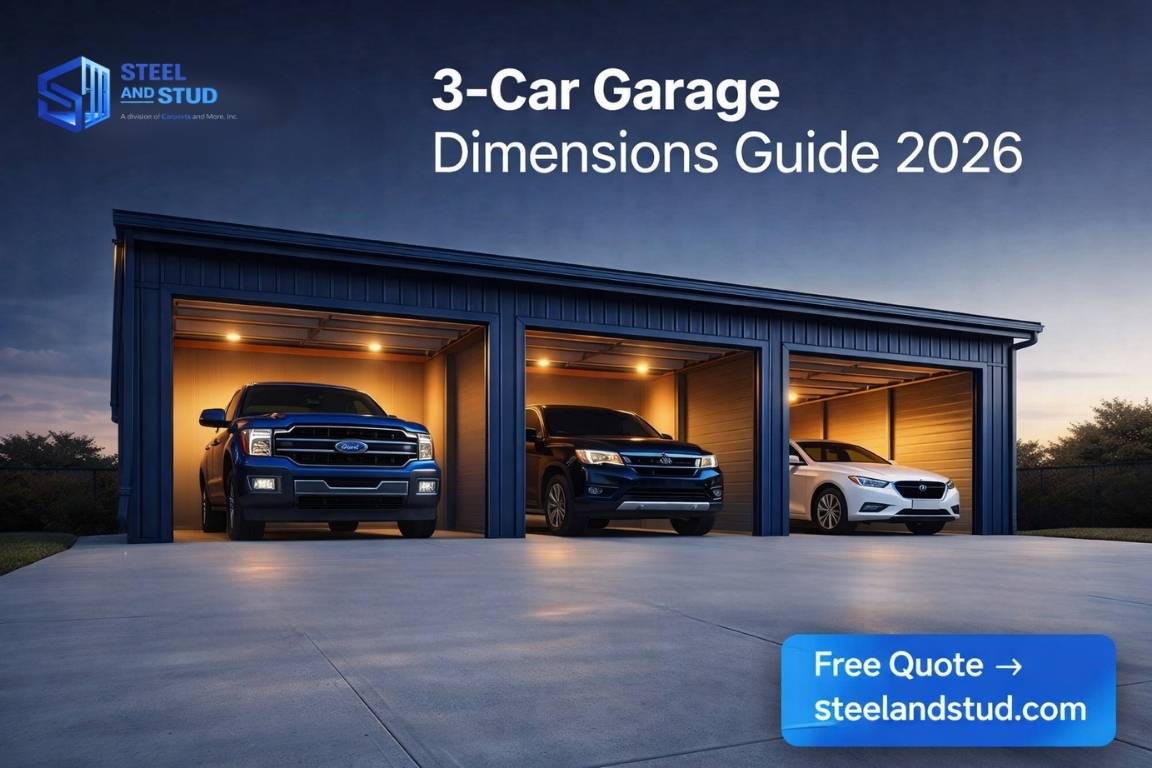
Having designed and delivered thousands of custom metal garages across the U.S., we at Steel & Stud have helped homeowners find the right 3-car garage dimensions for every situation — from compact suburban lots to sprawling rural properties. This guide covers everything you need to know about 3-car garage sizes, square footage, layouts, and planning considerations.
Families today own more than one vehicle, so having adequate parking space is essential. If you’re tired of squeezing cars into a cramped garage, it may be time to upgrade to a 3-car garage. With a 3-car garage, you get extra space for parking all your vehicles and storing equipment.
In this guide, we’ll walk you through the different 3-car garage dimensions and how to choose the right one for your needs.
Table of Contents
Quick Reference: Standard 3-Car Garage Dimensions
Here’s a quick-reference summary of the most common 3-car garage dimensions:
Type | Width | Depth | Square Footage |
Minimum | 30 ft | 20 ft | 600 sq ft |
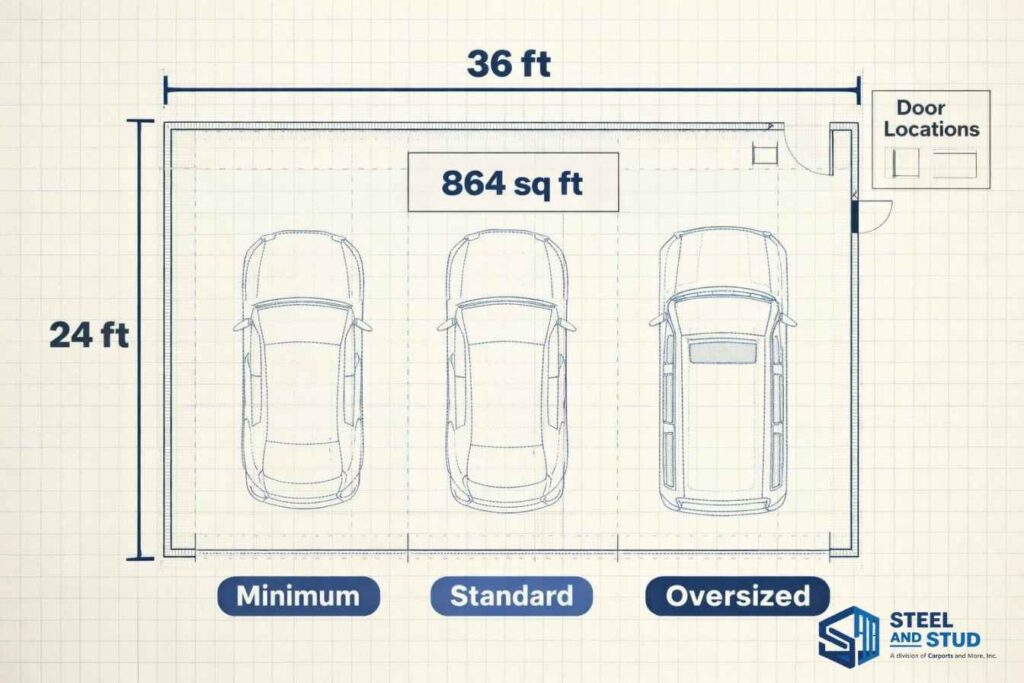
Standard | 36 ft | 24 ft | 864 sq ft |
Oversized | 40 ft | 30 ft | 1,200 sq ft |
Extra-Large (Workshop) | 42–60 ft | 30 ft | 1,260–1,800 sq ft |
- Garage door width (double door): 16–18 ft
- Garage door width (single door): 8–10 ft
- Garage depth: 22–30 ft
- Garage width: 30–60 ft
The ideal size of a 3-car garage for most homeowners is 36 x 24 feet (864 sq ft). However, your exact dimensions will depend on vehicle types, storage needs, and lot size.
3-Car Garage Size in Square Footage
The average 3-car garage square footage ranges from 600 sq ft to 1,200+ sq ft, depending on whether you go with a minimum, standard, or oversized layout.
Here’s what different square footage ranges look like in practice:
- 600–700 sq ft: Tight fit for three compact cars. Minimal storage space.
- 800–900 sq ft: Comfortable for three average-sized vehicles with some room for shelving.
- 1,000–1,200 sq ft: Spacious enough for three full-size trucks or SUVs, plus a workbench and storage.
- 1,200+ sq ft: Room for vehicles, a full workshop, and significant storage.
How to Calculate Your 3-Car Garage Square Footage
Calculating your garage’s square footage is straightforward:
- Measure the width (the wall with the garage doors) in feet.
- Measure the depth (from the garage door wall to the back wall) in feet.
- Multiply width × depth to get total square footage.
Example: A 36 ft × 24 ft garage = 864 sq ft.
For irregularly shaped garages (L-shaped, tandem), break the floor plan into rectangles, calculate each area separately, and add them together.
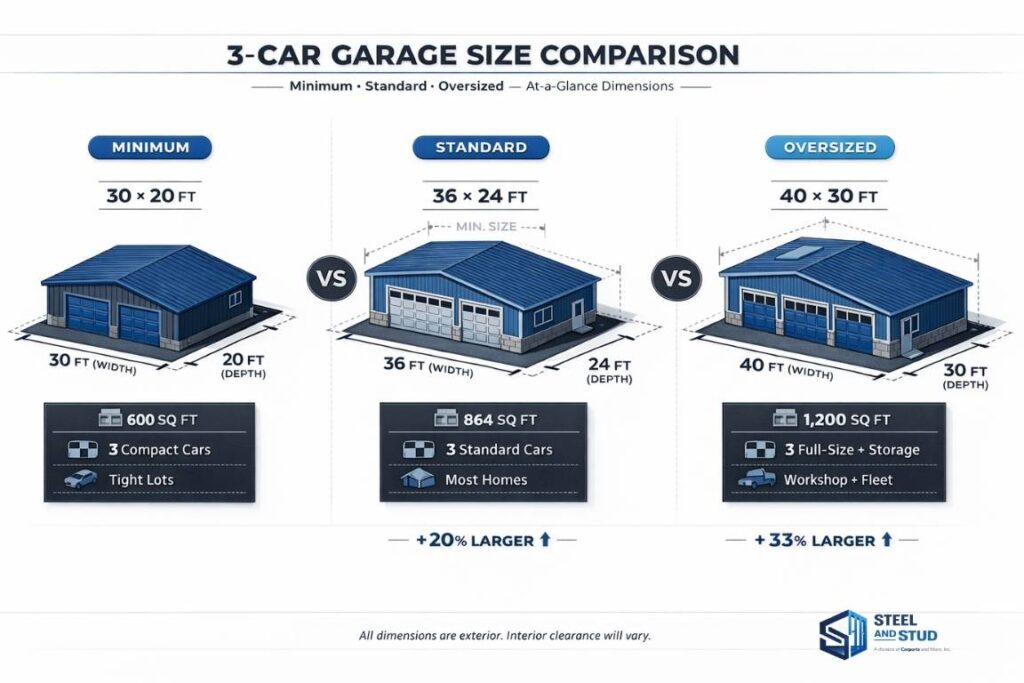
Minimum vs. Standard vs. Oversized 3-Car Garage Dimensions
Feature | Minimum | Standard | Oversized |
Width | 30 ft | 36 ft | 40–42 ft |
Depth | 20 ft | 24 ft | 30 ft |
Square Footage | 600 sq ft | 864 sq ft | 1,200–1,260 sq ft |
Best For | Compact cars only | Most families | Trucks, SUVs, workshops |
Storage Space | Very limited | Moderate | Ample |
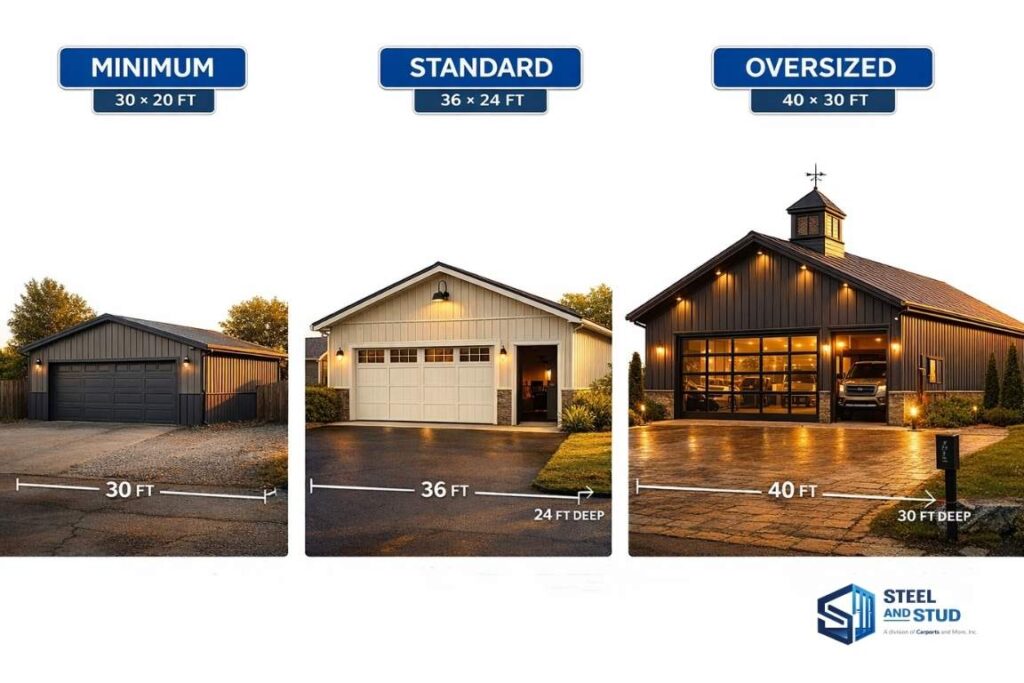
Minimum 3-Car Garage Dimensions
If you are looking for the smallest viable 3-car garage, you need at least 30 feet wide and 20 feet deep (600 sq ft). This will give you enough room to hold 3 compact vehicles, but you won’t have much extra space for storage.
A minimum-size 3-car garage works best for sedans and smaller vehicles. You’ll have roughly 10 feet per bay, which allows for door opening but leaves little room for walking around the vehicles. If you need a compact layout, a 20×40 metal garage can also work as a tight 3-car configuration with a deeper footprint.
Standard 3-Car Garage Size (Most Common)
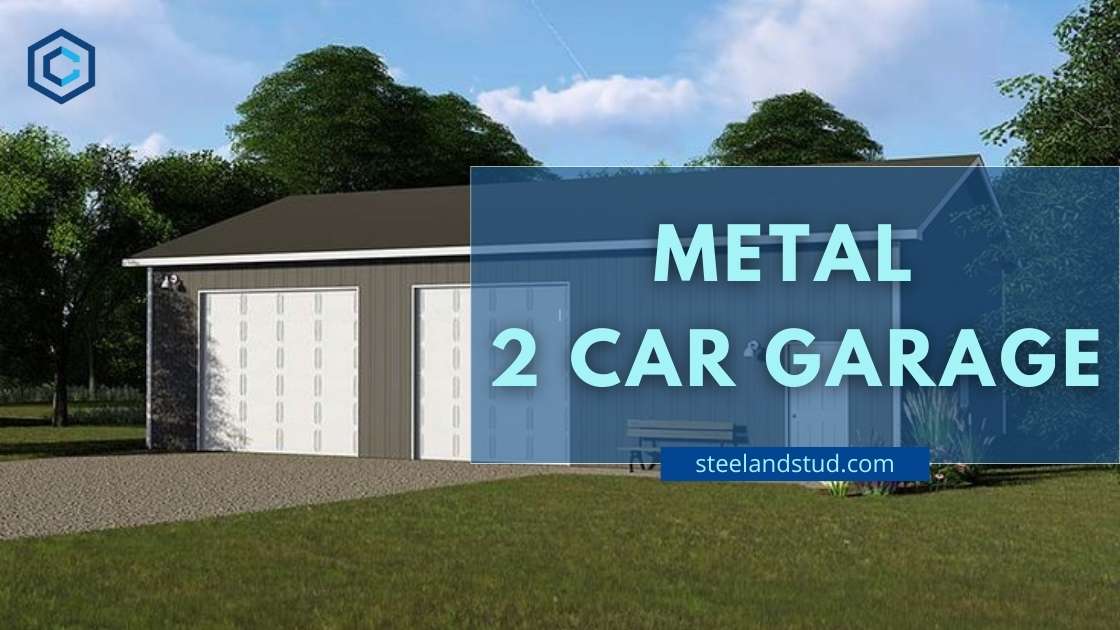
The standard 3-car garage size is approximately 36 feet wide and 24 feet deep (864 sq ft). This is the most commonly built configuration and provides comfortable space for three average-sized vehicles.
At 36 feet wide, each bay gets 12 feet of width — enough to open doors comfortably and walk between vehicles. A standard 24×36 metal building is one of the most popular options for this layout.
Typical door configuration for a standard 3-car garage:
- One 16-foot double door (covering two bays) + one 8- or 9-foot single door
- Or three individual 9-foot single doors
Oversized 3-Car Garage Dimensions
If you own full-size trucks, SUVs, or want workshop space, an oversized 3-car garage is the way to go. Common oversized dimensions include:
- 40 ft × 30 ft = 1,200 sq ft
- 42 ft × 30 ft = 1,260 sq ft
- 40 ft × 36 ft = 1,440 sq ft
For maximum space — such as a full workshop plus 3 vehicles — a 40×60 metal building provides 2,400 sq ft, which is more than enough for vehicles, tools, and a dedicated work area.
For a customer in Texas storing two F-150s and a sedan, we recommended a 38 ft × 26 ft metal garage with one 16-foot double door and one 10-foot single door. That extra width and depth made all the difference for daily use.
3-Car Garage Width: How Wide Should It Be?
Garage depth (also called length) is measured from the garage door wall to the back wall. The right depth depends on your vehicles:
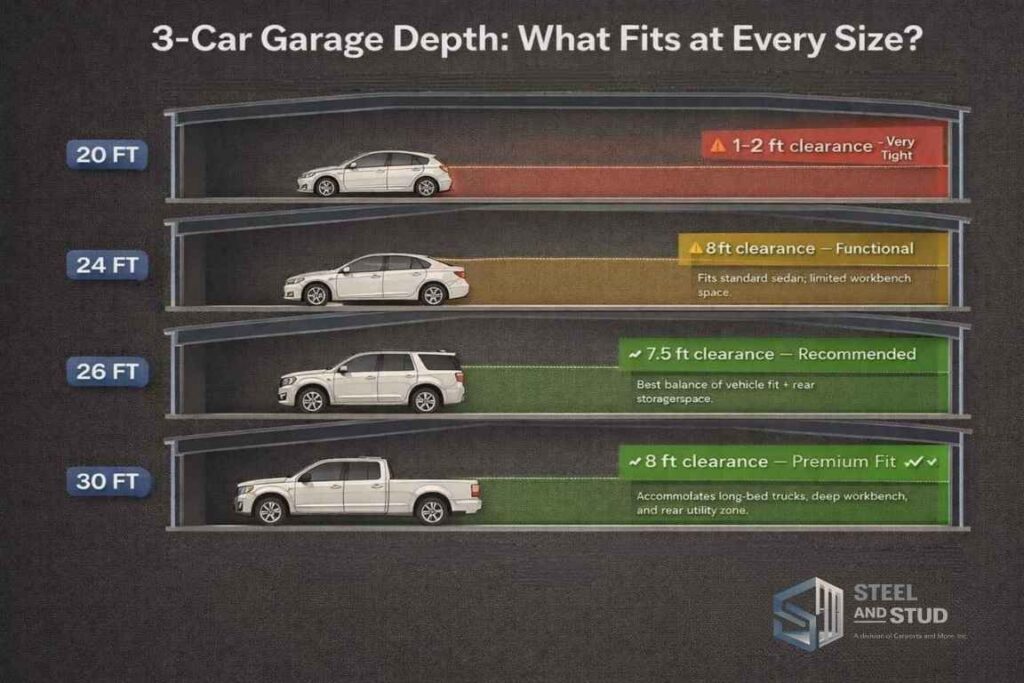
- 20 ft depth: Fits compact cars and sedans. Tight for anything larger.
- 24 ft depth: The standard. Fits most sedans, small SUVs, and mid-size trucks with room to walk behind the vehicle.
- 26–28 ft depth: Recommended for full-size trucks (F-150, Silverado, Ram 1500).
- 30 ft depth: Ideal for full-size SUVs, extended-cab trucks, and anyone who wants storage space behind the vehicles.
Remember: you need at least 3 feet of clearance behind the vehicle for walking and accessing the back wall. If you plan to install shelving or a workbench along the back wall, add another 2–3 feet.
3-Car Garage Depth and Length Explained
Width is the most critical dimension for a 3-car garage. Here’s a breakdown:
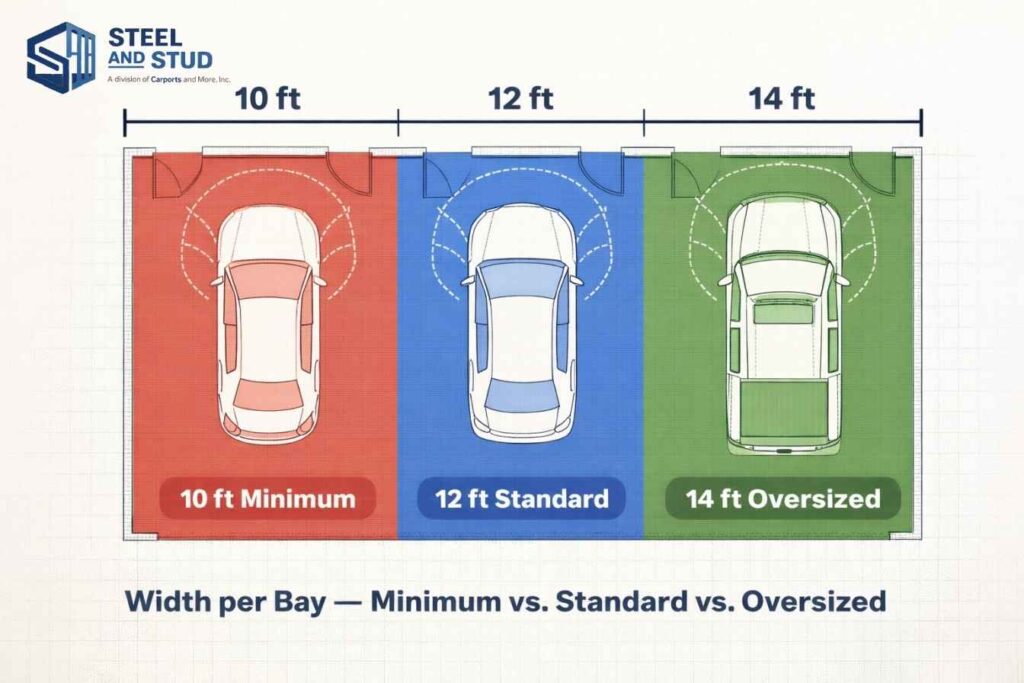
- Minimum width: 30 ft (10 ft per bay) — tight, works only for compact cars
- Standard width: 36 ft (12 ft per bay) — comfortable for most vehicles
- Oversized width: 40–42 ft (13–14 ft per bay) — ideal for trucks and SUVs
Is 30 ft wide enough for a 3-car garage? Technically yes, but barely. At 30 feet, each bay gets only 10 feet. After accounting for wall thickness and the space between vehicles, you’ll have very little room to open doors or walk around. We recommend 36 feet minimum for a comfortable 3-car garage.
Wider garages also give you more flexibility with door configurations and allow space for side-mounted shelving or a workbench along one wall.
3-Car Garage Dimensions by Vehicle Type
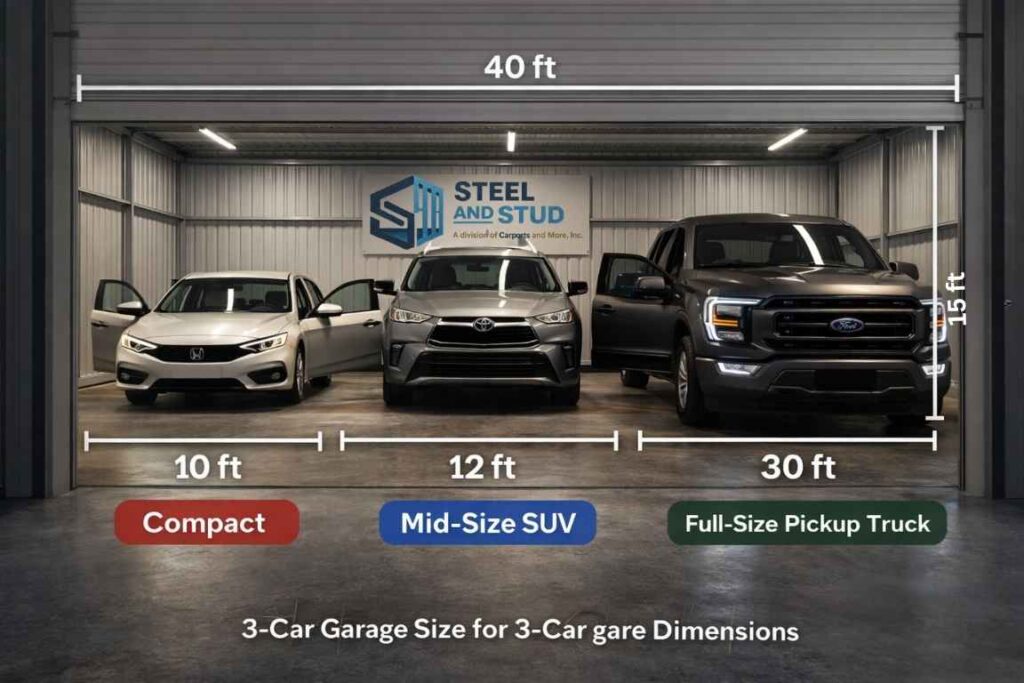
Choosing the right dimensions starts with knowing what you’ll park inside. Here are recommended 3-car garage dimensions based on vehicle type:
Vehicle Type | Avg. Vehicle Length | Avg. Vehicle Width | Recommended Garage Width | Recommended Garage Depth |
Compact Cars (Civic, Corolla) | 15 ft | 6 ft | 30–33 ft | 20–22 ft |
Mid-Size Sedans (Camry, Accord) | 16 ft | 6.5 ft | 33–36 ft | 22–24 ft |
SUVs (Explorer, Highlander) | 16–17 ft | 6.5–7 ft | 36–38 ft | 24–26 ft |
Full-Size Trucks (F-150, Silverado) | 19–20 ft | 6.5–7 ft | 36–40 ft | 26–30 ft |
Extended-Cab Trucks / Large SUVs | 20–22 ft | 7 ft | 40–42 ft | 28–30 ft |
What size garage do you need for 3 full-size trucks? We recommend at least 40 ft × 30 ft (1,200 sq ft). Full-size trucks like the F-150 are nearly 20 feet long and 7 feet wide, so you need the extra depth and width for comfortable access.
3-Car Tandem Garage Dimensions
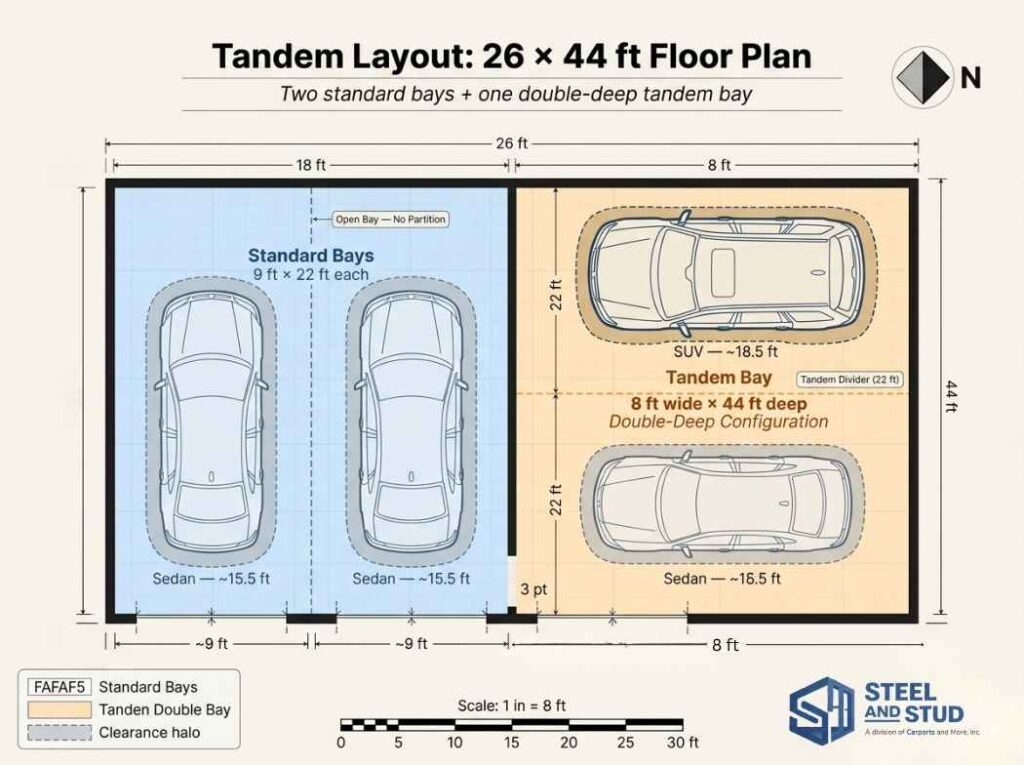
A tandem garage layout places one bay behind another (double-deep) instead of all three bays side by side. This is a great option when your lot is too narrow for a full-width 3-car garage.
Typical tandem 3-car garage dimensions:
- Width: 24–28 ft (two standard bays side by side)
- Depth: 40–48 ft (one bay is double-deep, fitting two cars in a line)
- Square Footage: 960–1,344 sq ft
In a tandem layout, two cars park side by side in the front, and the third car parks behind one of them. The double-deep bay needs to be at least 40 feet deep to fit two vehicles with clearance.
A 20×40 garage can serve as a starting point for a tandem 3-car configuration, though you may need additional width for comfortable side-by-side parking in the front bays.
Pros of tandem layouts:
- Narrower footprint fits tighter lots
- Can be more cost-effective (less foundation width)
Cons of tandem layouts:
- The rear vehicle is blocked by the front vehicle
- Less convenient for daily use
3-Car Garage Dimensions in Meters
For international readers, here are common 3-car garage dimensions converted to meters:
Type | Width (ft) | Depth (ft) | Width (m) | Depth (m) | Area (m²) |
Minimum | 30 ft | 20 ft | 9.1 m | 6.1 m | 55.7 m² |
Standard | 36 ft | 24 ft | 11.0 m | 7.3 m | 80.3 m² |
Oversized | 40 ft | 30 ft | 12.2 m | 9.1 m | 111.5 m² |
Quick conversion: 1 foot = 0.3048 meters. Multiply any dimension in feet by 0.3048 to get meters.
3-Car Garage Door Sizes and Configurations
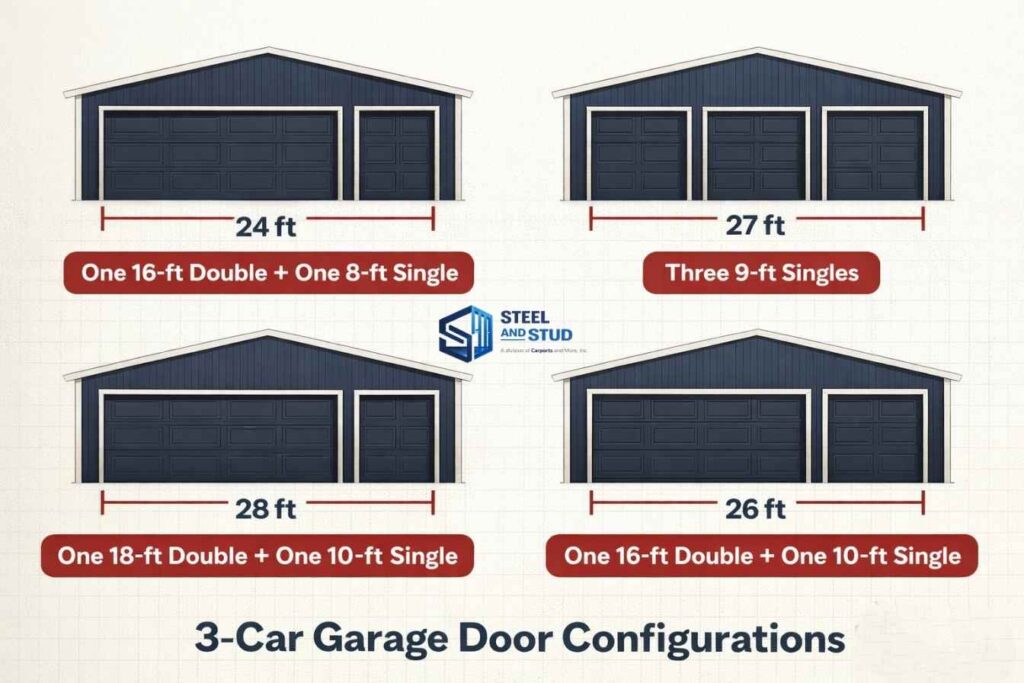
Your garage door configuration directly affects the overall width of your 3-car garage. Here are the most common options:
Standard garage door widths:
- Single door: 8 ft, 9 ft, or 10 ft wide
- Double door: 16 ft or 18 ft wide
- Door height: 7 ft (standard) or 8 ft (for trucks/SUVs)
Common 3-car garage door configurations:
Configuration | Total Door Width | Minimum Garage Width | Best For |
One 16 ft double + one 8 ft single | 24 ft of doors | 32–36 ft | Most common setup |
One 16 ft double + one 10 ft single | 26 ft of doors | 34–38 ft | Wider vehicles |
Three 9 ft singles | 27 ft of doors | 33–36 ft | Individual bay access |
One 18 ft double + one 10 ft single | 28 ft of doors | 36–40 ft | Oversized garages |
Leave at least 12–16 inches between each door and between doors and side walls for framing and structural support. If you’re building a steel garage, the framing requirements may differ — contact us for specifics.
Factors That Affect Your 3-Car Garage Size
Now that you know the standard dimensions for a 3-car garage, there are several factors to consider before finalizing your plans.
Types of Vehicles
Before building a 3-car garage, you must know the vehicles you’ll be storing. Since 3-car garages are spacious, you can store SUVs, trucks, or even motorcycles alongside your daily drivers. The size and type of your vehicles directly determine the width and depth you need.
Storage and Workshop Space
Do you need extra storage in your 3-car garage? Many families need room for tools, seasonal items, sports equipment, and lawn care gear.
Here’s how much extra space to plan for common additions:
- Wall-mounted shelving: Add 1–2 ft of depth along one wall
- Workbench: Add 2–3 ft of depth or width
- Freestanding storage cabinets: Add 2 ft of depth
- Freezer or extra refrigerator: Add 3 ft of width and ensure extra power outlets and insulation
If you plan to use part of your garage as a workshop, consider adding at least 4–6 extra feet of depth beyond what your vehicles need. This gives you a dedicated work zone without crowding your parking area.
Many people also use their garage space for various projects. If you plan to have a small workshop, you may want to increase the overall dimensions accordingly.
Building Codes and Permits for 3-Car Garages
According to the International Building Code (IBC) and International Residential Code (IRC), garages fall under specific use categories. The IRC 2021 edition (the most current widely adopted code) classifies private garages as accessory structures. Key requirements include:
- Private garages generally should not exceed 3,000 sq ft under the IRC for residential use (the 1,000 sq ft limit in the IBC applies to Group U occupancy in commercial contexts).
- Separation from living spaces requires fire-rated barriers per Section 302.6.
- Local jurisdictions may have additional setback, height, and lot coverage requirements.
Always check with your local building department before construction. Permit requirements vary by state and municipality. Building without proper permits can result in fines and may require you to modify or remove the structure.
Accessibility Considerations
If you or someone in your family uses a wheelchair, you’ll need a larger garage to load or unload the wheelchair comfortably.
The ADA recommends a minimum 8-foot-wide access aisle adjacent to the vehicle. For a 3-car garage, this typically means adding 3–5 extra feet of width to at least one bay. You might also want to consider adding a ramp to your garage for easier access.
Other Considerations
- How many cars do you actually park daily? If you only park two regularly, the third bay can serve as dedicated storage or workshop space.
- Do you want to add storage shelves? Think about placement — wall-mounted shelves along the back wall or side walls work best without eating into parking space.
- Do you want space for a workbench? A workbench typically needs 2–3 feet of depth and 4–6 feet of width. Factor this into your overall garage dimensions.
Does a 3-Car Garage Add Value to Your Home?
Yes. A 3-car garage can significantly increase your home’s resale value. According to the National Association of Home Builders (NAHB), a 3-car garage is among the most desired features for homebuyers, particularly in suburban and rural markets.
Here’s what the data shows:
- Homes with 3-car garages typically sell for 5–15% more than comparable homes with 2-car garages.
- In markets where trucks and outdoor recreation are popular (Texas, the Mountain West, the Southeast), the premium can be even higher.
- A well-built 3-car garage can return 60–80% of its construction cost at resale.
Beyond resale value, a 3-car garage provides practical daily benefits: protected vehicle storage, workshop space, and room for seasonal items that would otherwise clutter your home.
How Much Does a 3-Car Garage Cost to Build in 2026?
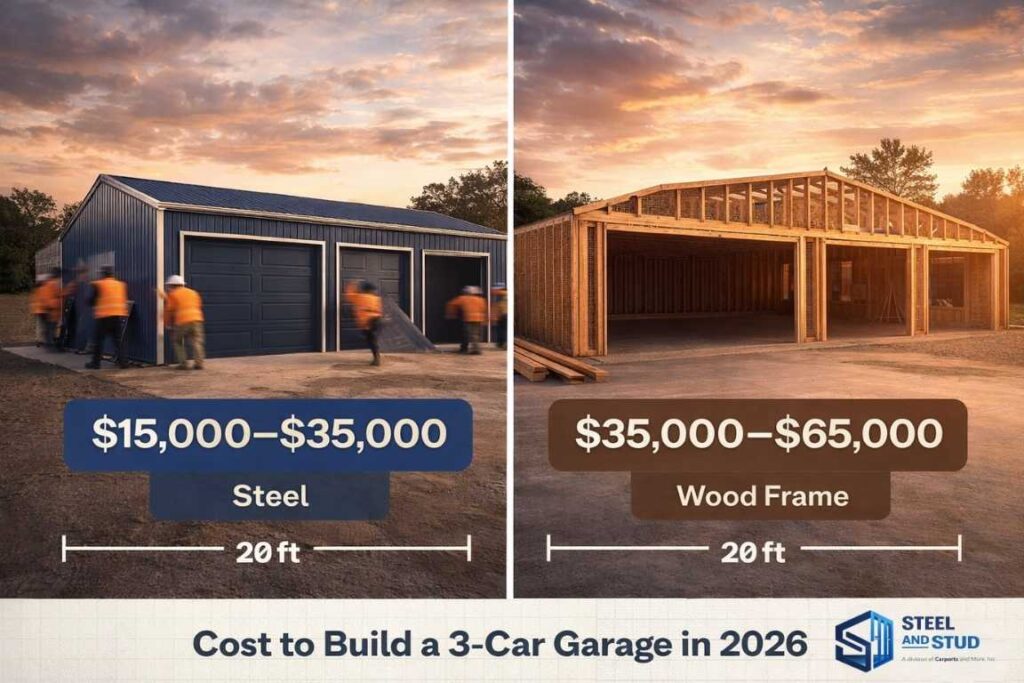
The cost to build a 3-car garage in 2026 varies based on materials, location, and features:
Construction Type | Cost Range (2026) | Notes |
Prefab Steel/Metal | $15,000–$35,000 | Most cost-effective; fast installation |
Wood Frame (Stick-Built) | $35,000–$65,000 | Traditional construction; higher labor costs |
Brick/Masonry | $50,000–$80,000+ | Premium finish; longest build time |
What affects the cost:
- Size: A 30×20 minimum garage costs far less than a 40×30 oversized build.
- Foundation: Concrete slab (4–6 inches thick) is standard. Thicker slabs for heavy vehicles cost more.
- Doors: Three single doors vs. one double + one single affects price.
- Insulation and finishing: Insulated, drywalled garages cost more than unfinished shells.
- Location: Labor and permit costs vary significantly by region.
A prefab steel 3-car garage from Steel & Stud is one of the most cost-effective options. Our metal garages are durable, low-maintenance, and can be installed in a fraction of the time compared to stick-built construction. A 30×40 metal building is one of our most popular sizes for 3-car garages.
Popular 3-Car Garage Layouts and Designs
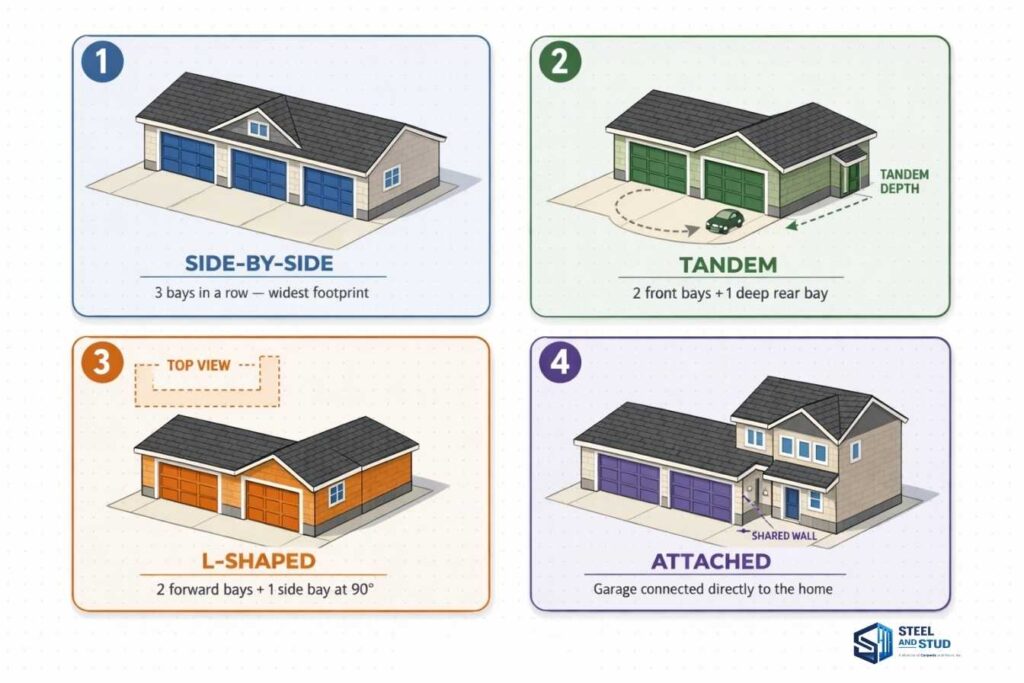
- Side-by-Side (Standard) All three bays are in a row. This is the most common layout, requiring the widest footprint (36–42 ft). Works best on wider lots.
- Tandem (Deep Bay) Two bays side by side with a third bay behind one of them. Narrower footprint (24–28 ft wide) but deeper (40–48 ft). Ideal for narrow lots.
- L-Shaped Two bays face one direction and the third bay faces a perpendicular direction. Great for corner lots or when you want a separate entrance for the third bay.
- Attached vs. Detached
- Attached: Connected to the house. Convenient access, but limited by home layout and setback requirements.
- Detached: Standalone structure. More design flexibility, can be placed anywhere on the lot, and often easier to build larger.
Why Choose a Steel 3-Car Garage?
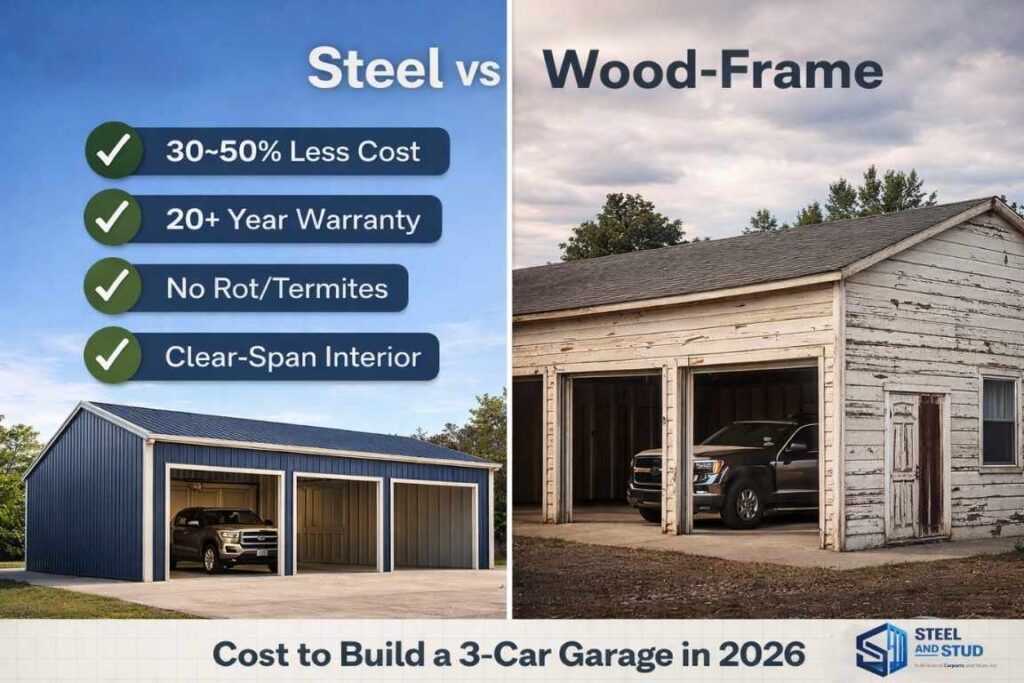
Steel garages offer several advantages over traditional wood-frame construction:
- Cost savings: Prefab metal garages typically cost 30–50% less than stick-built garages.
- Speed of construction: A steel 3-car garage can be erected in days, not weeks.
- Durability: Steel resists rot, termites, warping, and fire. Most metal garages come with 20-year+ warranties.
- Low maintenance: No painting, staining, or replacing rotted boards.
- Customizable: Choose your exact width, depth, height, door configuration, and color.
- Clear-span design: No interior support columns, so you get 100% usable floor space.
At Steel & Stud, we’ve delivered thousands of custom metal garages across the country. Whether you need a standard 24×36 metal building or an oversized 40×60 garage, we can build it to your exact specifications.
Comparison: 1-Car vs. 2-Car vs. 3-Car vs. 4-Car Garage Dimensions
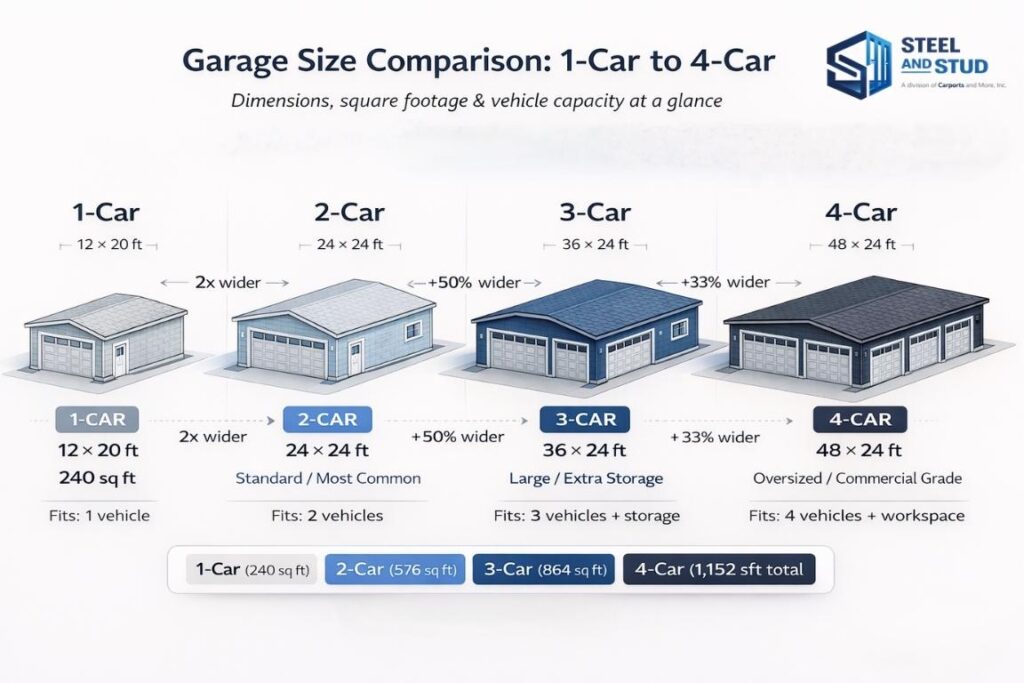
Garage Type | Standard Width | Standard Depth | Square Footage | Common Metal Building Size |
1-Car | 12 ft | 20 ft | 240 sq ft | |
2-Car | 24 ft | 24 ft | 576 sq ft | |
3-Car | 36 ft | 24 ft | 864 sq ft | |
4-Car | 48 ft | 24 ft | 1,152 sq ft |
If you’re currently in a 1-car garage (like an 18×20 garage) and considering an upgrade, jumping to a 3-car garage gives you the most flexibility for vehicles, storage, and future needs.
What Size of 3-Car Garage Is Best For You?
The right size depends on your specific needs and preferences.
A smaller 3-car garage (around 30 ft × 20 ft) might work if you don’t have many storage needs and only park compact vehicles. On the other hand, if you have a lot of belongings to store or need extra room for a workshop or vehicle repairs, a larger 3-car garage (40 ft × 30 ft or bigger) would be a better fit.
If you have a car collection or need to store multiple large vehicles, you’ll need at least a 36 ft × 24 ft garage. This size gives you plenty of space to store 3 cars comfortably.
If you own SUVs or trucks, you’ll need a garage at least 26 feet deep so you can open the doors fully without hitting the back wall. Most people with a pickup truck, full-size SUV, or minivan prefer a 3-car garage that is 30 feet deep so they can easily move around inside.
No matter what size you choose, consider your specific needs to find the perfect fit for your home.
Final Thoughts
The dimensions of a three-car garage vary depending on your vehicles, storage needs, and property. The most important things to remember are the size of your vehicles, how many you plan on parking, and any additional storage or workspace requirements.
Here’s a quick recap:
- Minimum 3-car garage: 30 ft × 20 ft (600 sq ft)
- Standard 3-car garage: 36 ft × 24 ft (864 sq ft)
- Oversized 3-car garage: 40 ft × 30 ft (1,200 sq ft)
Whatever you decide, we have a three-car garage that will suit your needs. Take some time to explore our metal garage options on steelandstud.com, or call 1-877-275-7048 to speak with a friendly sales rep about your three-car garage project.
FAQs About 3-Car Garage Dimensions
What is the minimum size for a 3-car garage?
The minimum 3-car garage size is 30 feet wide and 20 feet deep (600 sq ft). This fits three compact cars side by side with minimal extra space.
What is the standard 3-car garage size?
The standard 3-car garage size is 36 feet wide and 24 feet deep (864 sq ft). This is the most commonly built configuration.
How much square footage do three cars need in a garage?
When storing three cars side by side, you need 600–1,200 sq ft depending on vehicle size. For average-sized vehicles, plan for 800–900 sq ft.
Does the size of your car matter when determining garage dimensions?
Absolutely. Before building a 3-car garage, measure your vehicles to determine the right width and depth. Full-size trucks need significantly more space than compact sedans.
What is the best size for a 3-car garage?
For most homeowners, 36 ft × 24 ft is the sweet spot. If you have larger vehicles or want workshop space, go with 40 ft × 30 ft or larger.
Is 30 ft wide enough for a 3-car garage?
Barely. At 30 feet, each bay gets only 10 feet of width. You can park three compact cars, but opening doors and walking between vehicles will be tight. We recommend at least 36 feet for a comfortable 3-car garage.
Do 3-car garages increase home value?
Yes. Homes with 3-car garages typically sell for 5–15% more than comparable homes with 2-car garages. The return on investment is especially strong in suburban and rural markets.
What does a 3-car garage cost to build in 2026?
Costs range from $15,000–$35,000 for a prefab steel garage to $35,000–$80,000+ for wood-frame or masonry construction. The final cost depends on size, materials, foundation, and location.
How many cars fit in a 30x40 garage?
A 30×40 garage (1,200 sq ft) comfortably fits 3 vehicles with room for storage and a workbench. If you need even more space, check out our 40×60 garage options.
What are the 3-car garage dimensions in meters?
A standard 3-car garage (36 ft × 24 ft) is approximately 11.0 m × 7.3 m (80.3 m²). See the full conversion table above.
What are the most common 3-car garage designs?
The most popular layouts are side-by-side (all three bays in a row), tandem (one deep bay behind another), L-shaped, and attached vs. detached configurations. Steel & Stud offers custom designs for all of these layouts.
Are there any special permits required to build a 3-car garage?
Permit requirements vary by state and municipality. Check with your local building department before construction. Most areas require a building permit for any structure over a certain size.
How many vehicles can fit in a 30x30 garage?
A 30×30 metal building (900 sq ft) can fit 3 compact to mid-size vehicles. For larger vehicles, you may want to go wider or deeper.
What type of materials should be used in a 3-car garage construction project?
Steel is the most cost-effective and durable option for a 3-car garage. Prefab metal garages from Steel & Stud offer faster installation, lower maintenance, and longer lifespans compared to wood-frame construction.