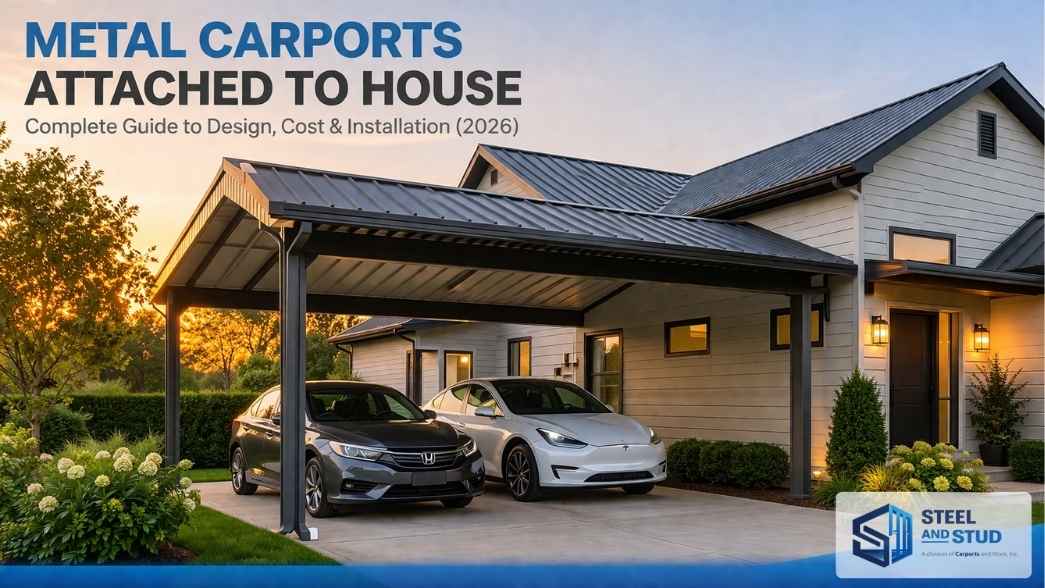
Worried that an attached carport won’t blend easily with your house? Rest assured—nothing is impossible. Metal carports attached to homes are not just convenient but offer supreme protection for your vehicles, equipment, and outdoor living space.
An attached metal carport (also called a lean-to carport) connects directly to your home’s existing wall, sharing one structural side with the house. It’s one of the most cost-effective ways to add covered parking and storage without the expense of building a full garage.
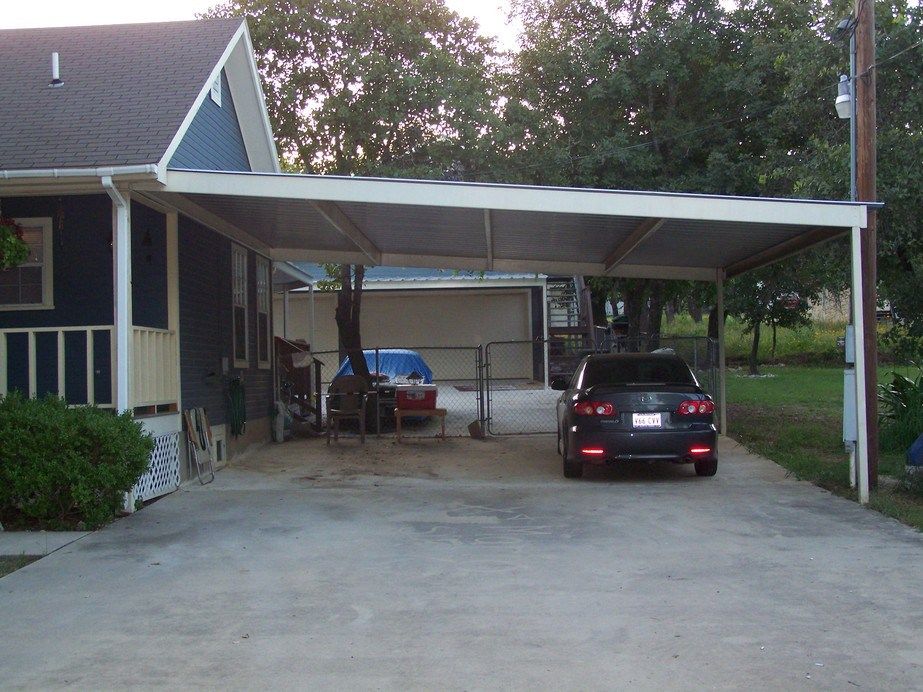
Some homeowners worry that the affordable prices of a metal building might come at the cost of curb appeal. That’s simply not the case. Attaching a carport to your building is achievable, and with the right design choices, the two structures complement one another beautifully.
Steel frames offer robust support for the unit’s roof in a custom metal carport. So, you get a carport that doesn’t just ace the looks of your outdoors but stands tall and strong against wind, rain, snow, and UV exposure.
Some homeowners prefer to transform their steel carports into garages at some point. You can add side and back walls, garage doors, windows, and entry doors for additional storage space. You can also check out carport designs that can accommodate an RV and still allow room for storage.
Depending on the style of your house, you can go for a custom metal carport kit to attach to your house, which can also be easily detached later. Different sizes of steel carports are available, and you can pick a design that functions as a single-car, 2-car carport, or even a triple-wide structure. You can design your carport using the Steel and Stud carport builder.
Table of Contents
What Is an Attached Metal Carport?
An attached metal carport is a covered structure that shares at least one wall—or a ledger board connection—with your existing home. Unlike a freestanding carport that stands independently in your yard, an attached carport uses your house’s wall as its primary support on one side, with steel or aluminum support posts on the outer side.
You may hear attached carports called by several names:
- Lean-to carport – the most common term, referring to the single-slope roof that “leans” against the house
- Carport addition – emphasizes that it adds square footage to your property
- Carport cover attached to house – a general descriptor used by many homeowners
Attached vs. Freestanding Carports: Key Differences
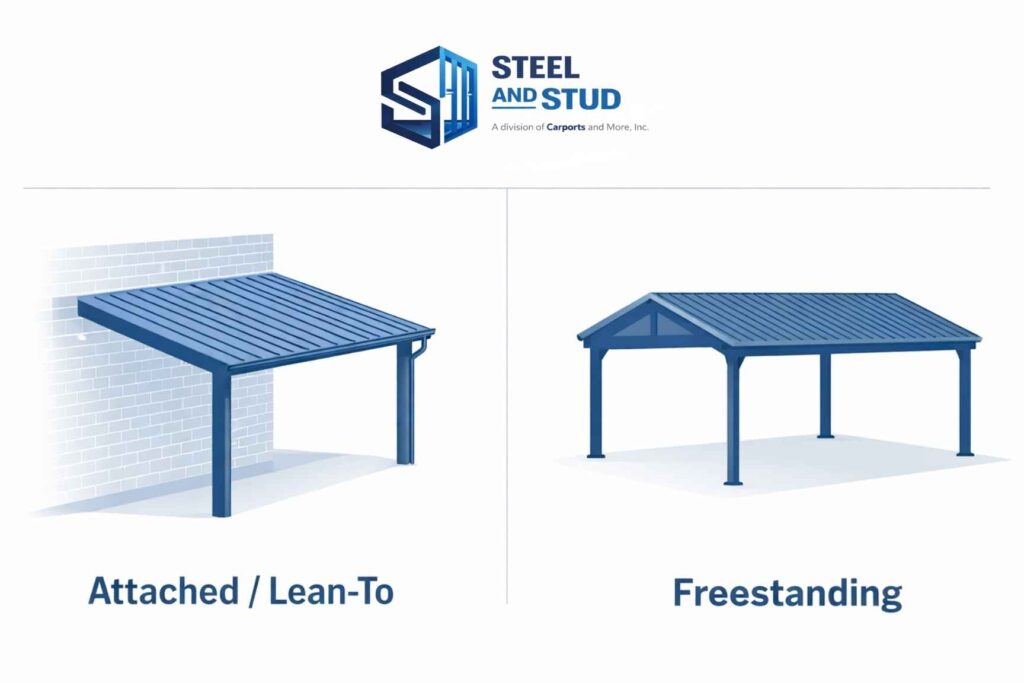
Feature | Attached Carport | Freestanding Carport |
Structural support | Uses house wall on one side | Independent on all sides |
Cost | Lower—fewer posts and footings needed | Higher—requires full frame |
Convenience | Direct access from home | Requires walking across yard |
Permits | Usually required (modifies existing structure) | Varies by jurisdiction |
Installation time | 1–3 days (kit) / 2–5 days (custom) | 1–3 days (kit) / 2–5 days (custom) |
Property value impact | Generally positive—looks integrated | Neutral to positive |
Placement flexibility | Limited to house walls | Can be placed anywhere on lot |
Can a Metal Carport Be Attached to Any House?
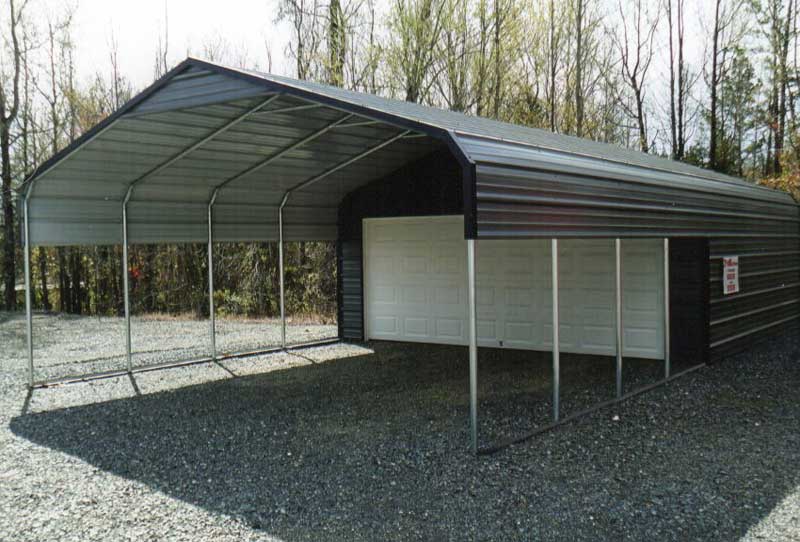
In most cases, yes—but there are a few structural requirements to keep in mind:
- Load-bearing wall – The wall where the ledger board attaches must be load-bearing or properly reinforced. Consult a structural engineer if you’re unsure.
- Wall material – Brick, concrete block, wood-framed, and steel-sided walls can all support an attached carport with the correct fasteners and flashing.
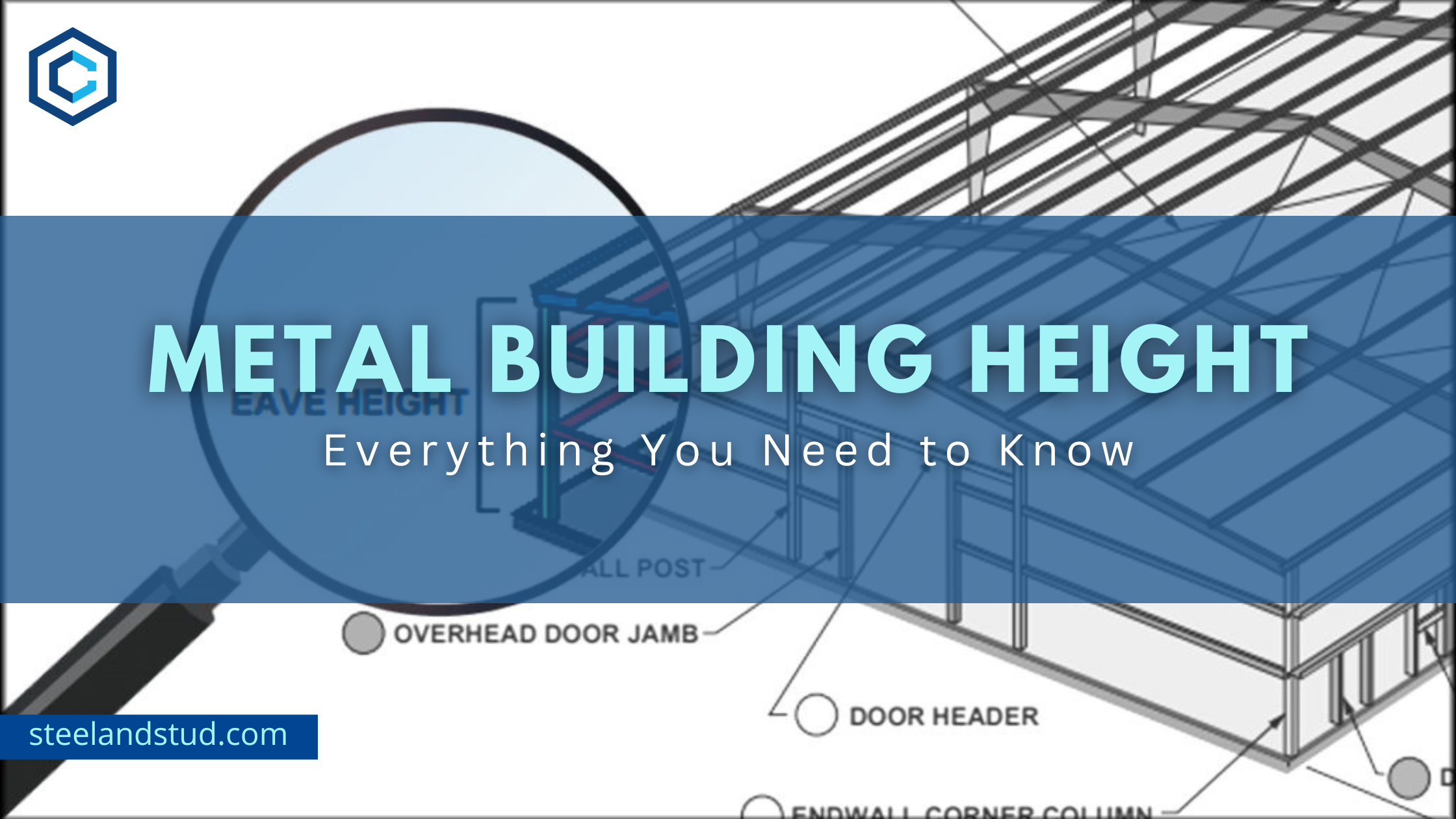
- Eave height – You need adequate height under the existing roofline’s eave to maintain proper roof pitch on the carport.
- Mobile homes – Attached carports for mobile homes require special consideration because manufactured housing frames differ from site-built homes. Lightweight aluminum carports for mobile homes are a popular solution (more on this below).
If your home’s wall isn’t suitable for direct attachment, a close-set freestanding carport positioned just inches from the house can achieve a similar look.
Benefits of Attaching a Metal Carport to Your Home
When investing in a steel carport, you invest in an adaptable and flexible structure. These can be used around your business or home in various ways. You will also be saving on maintenance costs in the long run, returning your investment amount several times over.
Here are the top benefits homeowners enjoy in 2026:
- Vehicle protection – Shield cars, trucks, boats, and RVs from hail, UV damage, rain, and falling debris
- Lower cost than a garage – An attached carport typically costs 50–70% less than a comparable enclosed garage addition
- Increased property value – A well-designed carport addition can boost resale appeal (see our property value section below)
- Versatile covered space – Use it as a workshop, outdoor entertaining area, or storage for lawn equipment and heavy machinery
- Quick installation – Most attached carport kits go up in 1–3 days, far faster than a garage build
- Curb appeal – Custom metal carports matched to your home’s color and style enhance your exterior
Hosting get-togethers under these metal structures is also not unheard of—it can spice up the fun quotient of your parties. Not to forget, adding a custom building or steel structure outside your home in an inventive manner can also benefit you in the future if you ever wish to sell your property. The best metal buildings help you in so many ways that you might easily overlook the long-term benefits when choosing between building materials.
Types of Attached Metal Carports
Attached carports come in several configurations. The right choice depends on your home’s layout, the number of vehicles you need to shelter, and your local building codes.
Lean-To Carport Attached to House
Suppose you have adequate height under the existing structure’s eave. In that case, you can easily attach a steel carport against the side of the building. Also called a lean-to, an attached carport can be installed using basic pole-building construction.
You can choose your aluminum or steel carport from various sizes and save hundreds of dollars on professional assembly by going for DIY carports. Whether you want a flat pan or a W pan system is up to you. Both are equally strong, ready-to-assemble, and versatile in their own way. They are engineered to meet local code requirements.
If you like a corrugated-shape ceiling, pick a W pan. In case you prefer a flat ceiling, a flat pan is what you should be looking for. Our steel carports guarantee corrosion resistance and are distinguished by their pre-drilled holes and pre-cut extrusions for easy installation.
Imagine the ease of putting your lawnmower, trucks, boats, cars, and tractors in a safe and sound location when not in use once the carport project reaches completion.
Carport Attached to Side of House
A carport attached to the side of your house is the most popular placement option. It keeps vehicles close to an entry door—often a side or back door—for convenient access in bad weather.
When planning a side-mounted carport, consider:
- Setback requirements – Most municipalities require a minimum distance (typically 3–5 feet) between the carport’s outer edge and your property line
- Drainage – Ensure the roof pitch directs water away from your foundation; install gutters and downspouts
- Utility clearances – Check for gas meters, electrical panels, or HVAC units on the wall where you plan to attach
A 20×20 metal building footprint works well for a standard side-of-house 2-car carport.
Carport Attached to Front of Garage
If you already have a garage but need additional covered parking, adding a carport to the front of your garage extends your sheltered area without a major renovation. The carport roof ties into the existing garage fascia or roofline, creating a seamless extension.
This setup is ideal for:
- Protecting a second or third vehicle that doesn’t fit inside the garage
- Creating a shaded workspace right outside the garage
- Sheltering an RV or boat that’s too tall for the garage opening
A 20×40 metal building configuration is a common choice for garage-front carport extensions.
Attached Carports for Mobile Homes
Attached carports for mobile homes require special attention because manufactured housing has a lighter frame than site-built homes. Here’s what you need to know:
- Use a freestanding-style frame positioned flush against the mobile home rather than bolting a ledger board directly into the mobile home wall. This avoids compromising the home’s structural integrity.
- Aluminum carports for mobile homes are the most popular choice—they’re lightweight, rust-resistant, and affordable.
- Anchor bolts should be driven into concrete footings or ground anchors rated for your local wind zone (mobile home parks often have specific wind-zone requirements).
- Check park rules – If your mobile home is in a community or park, the management may have restrictions on carport size, color, and placement.
Steel and Stud offers custom metal carport kits designed specifically for manufactured housing installations.
2-Car and Double Attached Carports
A 2-car carport attached to your house is the most requested size. Standard dimensions for a double carport range from 20 × 20 feet to 24 × 24 feet, providing enough clearance for two full-size vehicles plus door-opening room.
For larger households, a triple carport (approximately 30 × 20 feet) accommodates three vehicles or two cars plus a workshop area. Browse 30×30 metal building options for oversized configurations.
How to Attach a Metal Carport to Your House: Step-by-Step
Whether you’re tackling a DIY attached carport kit or working with a contractor, the process follows the same core steps. Here’s how to build a carport attached to your house from start to finish.
Step 1: Check Local Permits and Building Codes
Building an attached carport will likely require a local building permit in your area. You must check with your local building department and get ready with the necessary paperwork before breaking ground.
Do you need a permit for an attached carport? In most U.S. jurisdictions in 2026, yes. Because the structure physically connects to your home, it’s typically classified as a home addition or alteration. Key permit considerations include:
- Permit fees – Usually range from $75 to $500 depending on your county
- Setback requirements – Minimum distances from property lines, sidewalks, and easements
- HOA restrictions – Homeowner associations may have rules about carport materials, colors, and placement
- Wind and snow load ratings – Your local code will specify minimum engineering requirements
What happens if you build a carport without a permit? You risk fines, forced removal of the structure, complications with homeowner’s insurance claims, and problems when selling your home. It’s never worth skipping this step.
When building your own carport, you don’t want a small oversight like that to derail your metal carport building project.
Step 2: Measure and Plan the Layout
The first and foremost thing you must do is take the measurements of the space where you plan to construct the carport. Clear the area where you want to build the shelter to ensure the space is neat and even throughout. This helps you park vehicles in the carport easily.
Start by measuring from the wall of your home to the desired width—typically 3 meters (about 10 feet) for a single-car carport or 6 meters (about 20 feet) for a double. You also need to measure parallel to your home for the carport’s length, which can be 6 meters or more.
Subsequently, nail pegs into the ground at the four corners. Insert hurdles into the ground a bit farther from each peg to prepare the area for string lines.
Attach string lines – Use high-quality string lines attached from one hurdle to another. Ensure that each string line touches two of the pegs. This helps you create the rectangular footprint of the carport. Remove the pegs—the corners formed by the strings are where your concrete post footings will be set.
Ensure the layout is square – Measure the corners diagonally. If the diagonal measurements aren’t equal, adjust the string lines until you achieve a perfect square or rectangle.
Step 3: Prepare the Foundation
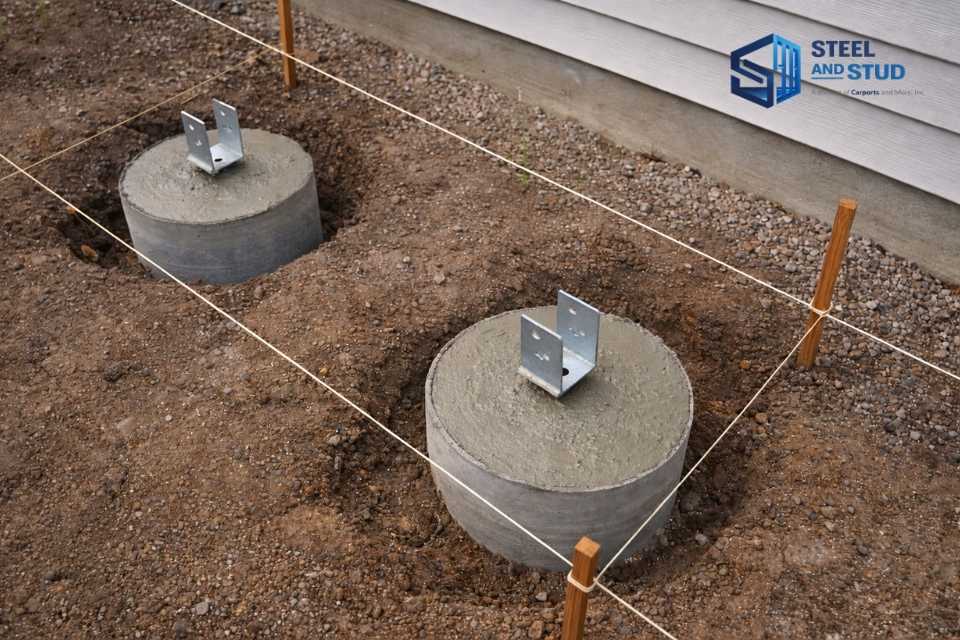
Do you need a foundation for an attached carport? Custom metal carports attached to the house don’t usually require a full poured foundation, but a level site is necessary for a firm hold. Your foundation options include:
- Concrete footings – The most common choice. Dig holes at each post location, set tube forms, and pour concrete. Ideal for most soil types.
- Concrete slab – Best if you want a clean, finished floor surface. A 4-inch slab with wire mesh reinforcement is standard.
- Auger anchors – If you plan to build a carport on a bare surface without pouring concrete, auger-style ground anchors keep the steel carport standing strong.
- Asphalt or mobile home anchors – Specialty anchors for existing paved surfaces or manufactured housing pads.
If using rebar anchors, drill a hole into the rail’s base and secure the structure to the ground by fixing it with the anchor.
Dig holes on all four corners (and at intermediate post locations for wider spans). The depth of each hole depends on your soil type and local frost line—typically 24 to 42 inches deep. Mix and add cement to each post hole. Use a post saddle pushed to the center of the hole; the saddle should sit about 25mm below grade and must be set while the cement is wet.
Have a helper hold each post tightly in the saddle while you check it for plumb with a spirit level. Drill through the saddle holes to insert coach bolts and nuts, then tighten them to lock the post in position.
Step 4: Install the Ledger Board and Header
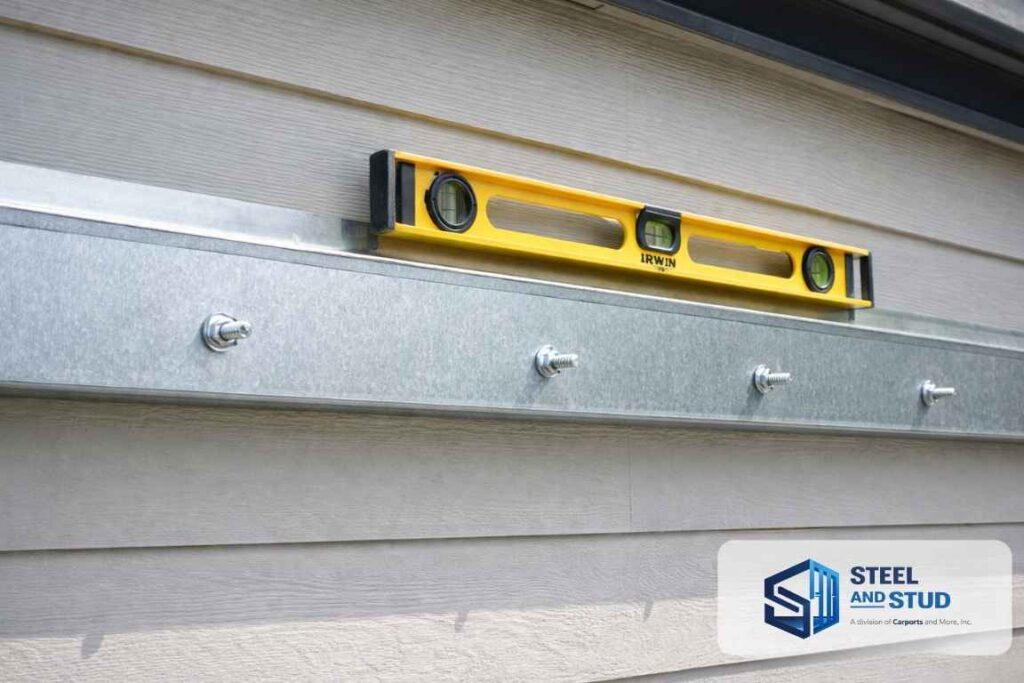
To attach a metal carport to your existing structure, first anchor the support header (ledger board) to your home’s wall. The ledger board is the horizontal beam that transfers the carport’s roof load into the house framing.
After dropping a plumb line from each side on the free side of the carport, determine the positions of the outer support posts. Consider laying out the building using string lines and the 3-4-5 triangle method to ensure everything is square.
Ledger board installation tips:
- Use lag screws or through-bolts into the home’s wall studs or masonry
- Install metal flashing above the ledger board to prevent water intrusion behind the board
- Ensure the ledger is level—this determines the entire carport’s roof pitch
- For brick or block walls, use concrete sleeve anchors rated for your carport’s load
Step 5: Set Support Posts and Beams

Using temporary braces, lock the posts into place. Before filling the tube forms with concrete, the posts need to be perfectly plumb. Make sure the surface is level. Leave the concrete to cure for at least 48–72 hours before applying any load.
The next step is to clamp the support beams to the tops of the posts. With a spirit level, ensure that the beams are horizontal. After confirming that the posts are vertical, fit the braces and secure them using structural screws.
Before fitting support beams, take careful measurements—where you place the support beam will influence the roof’s slope (pitch).
Step 6: Install Rafters and Roofing
Allow the posts to set, then install outer rafters or end boards. With an assistant holding the rafters, determine the outer roof height. Mark the height of the outer roof (the rafter’s bottom) and the angles where the rafter meets the existing structure’s wall and the header.
Build rafters and secure them to the support beams. Attach trim to the rafters’ ends so your carport achieves a neat appearance. Once the edges are aligned, fix the trim to the rafters using finishing nails.
Building the roof requires extreme care. Use slats and attach them to the rafters from the bottom up to the top. Fix them using galvanized screws so the upper slat protects the screw heads from moisture.
Roof pitch recommendation: A minimum slope of 1:12 (1 inch of drop per 12 inches of run) is required for metal roofing panels to shed water properly. A 2:12 to 4:12 pitch is ideal for most lean-to carport designs.
Step 7: Add Finishing Touches and Trim
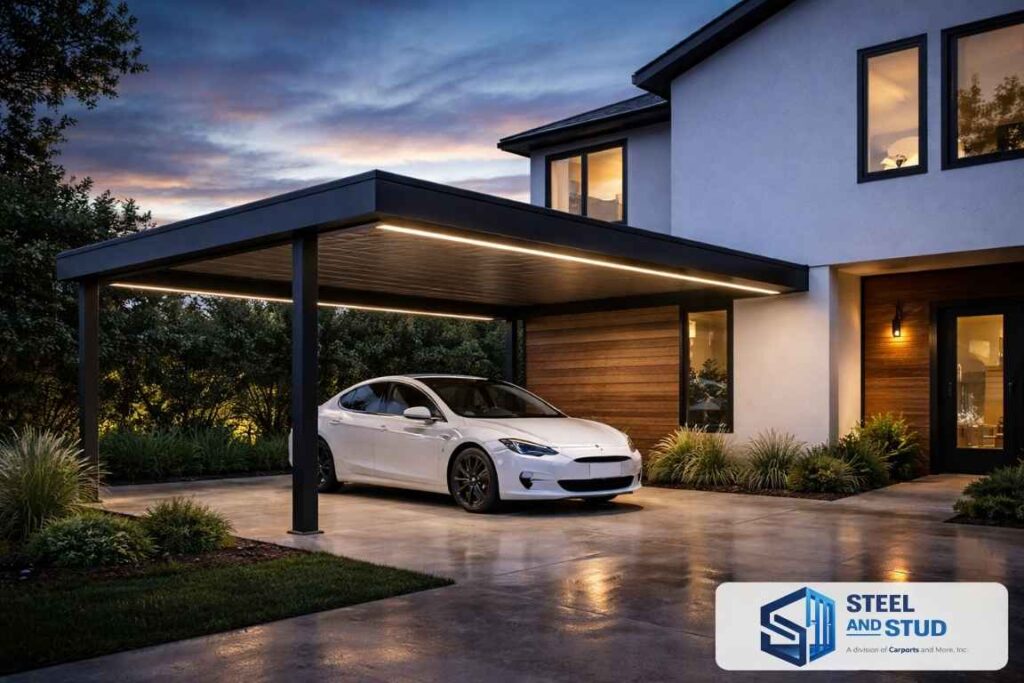
The connection where your carport meets the house is the most vulnerable point for water leaks. Proper finishing is critical:
- Step flashing or counter-flashing – Install along the entire length where the carport roof meets the house wall
- Gutters and downspouts – Direct rainwater away from your foundation; size gutters for your local rainfall intensity
- Trim and fascia – Match your home’s existing trim color for a cohesive look
- Sealant – Apply high-quality exterior caulk at all wall-to-roof transitions
- Paint or powder coating – If your carport frame isn’t pre-finished, apply rust-inhibiting primer and paint rated for exterior metal
Insert finishing nails after ensuring that all edges are aligned. A well-finished carport should look like a natural extension of your home—not an afterthought.
Attached Carport Kits: A Faster Alternative
If a full custom build feels overwhelming, an attached carport kit is a faster, more budget-friendly path. Pre-engineered kits from Steel and Stud arrive with:
- Pre-cut and pre-drilled steel or aluminum components – No on-site cutting or welding required
- All hardware included – Anchor bolts, screws, brackets, and flashing
- Step-by-step assembly instructions – Most kits are designed for DIY installation in 1–3 days with two people
- Engineered drawings – Certified plans you can submit with your building permit application
Popular attached carport kit sizes in 2026:
Kit Size | Vehicles Covered | Approx. Kit Price |
12 × 20 ft | 1 car | $1,800 – $3,500 |
20 × 20 ft | 2 cars | $2,800 – $5,500 |
24 × 30 ft | 2 cars + storage | $4,200 – $7,500 |
20 × 30 ft | 3 cars or RV | $5,000 – $9,000 |
*Prices reflect 2026 kit-only costs; foundation, permits, and installation labor are additional.*
Design your perfect attached carport kit using the Steel and Stud carport builder and get a free quote today.
How Much Does an Attached Carport Cost in 2026?

The cost incurred for building steel carports or metal carports attached to a house typically ranges from $3,500 to $11,000 in 2026. However, the average cost is around $7,000. Various factors considered when calculating the cost include unit size, features, site preparation, permit expenses, concrete slab, and finish color.
Constructing a carport does not put much weight on your wallet compared to a full garage. It lets you keep vehicles protected from extreme weather conditions and can also double as a storage space or workspace when you’re not parking.
Cost by Size (Single, Double, Triple, RV)
The cost to build a carport is heavily influenced by size—larger structures require more material and labor. These permanent structures can withstand hail and storms, and the color and material can be matched to the rest of your home.
Carport Size | Dimensions | Vehicles | Estimated Cost (2026) |
Single | 12 × 20 ft | 1 car | $2,600 – $7,800 |
Double | 20 × 20 ft | 2 cars | $3,500 – $13,000 |
Triple | 20 × 30 ft | 3 cars / SUVs / trucks | $6,500 – $19,500 |
RV | 20 × 30 ft (14 ft+ tall) | 1 RV + vehicle | $6,500 – $19,500 |
The larger carports allow you to park more vehicles and larger RVs. A 20×40 metal building is another popular option for homeowners who need extra length.
Cost by Material (Steel, Aluminum, Wood, Polycarbonate)
The material you choose greatly impacts the cost of the carport. The most widely used materials include steel, aluminum, wood, and polycarbonate.
Material | Cost per Sq Ft (2026) | Best For |
Steel | $10 – $32 | Durability, wind/snow resistance, long lifespan |
Aluminum | $12 – $28 | Lightweight, rust-free, mobile homes |
Polycarbonate | $13 – $22 | Modern aesthetics, UV filtering, DIY-friendly |
Wood | $16 – $32 | Custom designs, rustic style, craftsman homes |
Steel carports are open on all sides and come in freestanding, attached, and portable styles. Polycarbonate panels aren’t completely plastic—the thick sheets withstand rain, snow, and UV rays while giving your home a modern, aesthetically appealing look. Wood is bulkier but allows you to create fully custom carport structures in various wood species.
Additional Costs: Foundation, Permits, and Installation
Don’t forget these additional expenses when budgeting your attached carport project in 2026:
Cost Category | Estimated Range |
Concrete slab (4-inch) | $5 – $10 per sq ft |
Concrete footings only | $200 – $600 total |
Building permit | $75 – $500 |
Professional installation | $1,000 – $3,500 |
Metal roofing panels | $500 – $800 |
Polycarbonate roofing | $500 – $800 |
Shingle roofing | $250 – $400 |
Gutters and downspouts | $200 – $500 |
Electrical (lighting/outlets) | $300 – $800 |
By structure type:
- Attached carport: $1,500 – $11,000
- Freestanding carport: $1,000 – $7,000
- Portable carport: $400 – $1,300
💡 Ready to price your project? Use the Steel and Stud carport builder to configure your ideal attached carport and get an instant 2026 quote—no obligation.
15 Attached Carport Design Ideas with Photos
Your unused backyard or front area is an ideal place to construct a carport for parking your vehicles. A metal carport attached to house comes in open style, making it easy to park without having to open a gate. It features a roof supported by beams—simple, functional, and far more affordable than a full garage.
You can customize the carport with different design ideas to make it beautiful and add elegance to your home. Installing a metal carport allows you to store multiple vehicles such as RVs, boats, and cars. These structures are easier to install and cost-effective.
Here are 15 attached carport design ideas to inspire your 2026 project:
1. Modern Flat-Roof Metal Carport
A sleek, minimalist flat-roof carport uses clean steel framing and smooth metal panels to complement contemporary homes. The horizontal roofline creates a seamless transition from your home’s existing architecture. This design works especially well as a carport attached to side of house on modern builds.
Pair it with LED strip lighting underneath for a striking nighttime look. The flat roof also makes an excellent candidate for future solar panel installation.
2. Lean-To Carport with Storage
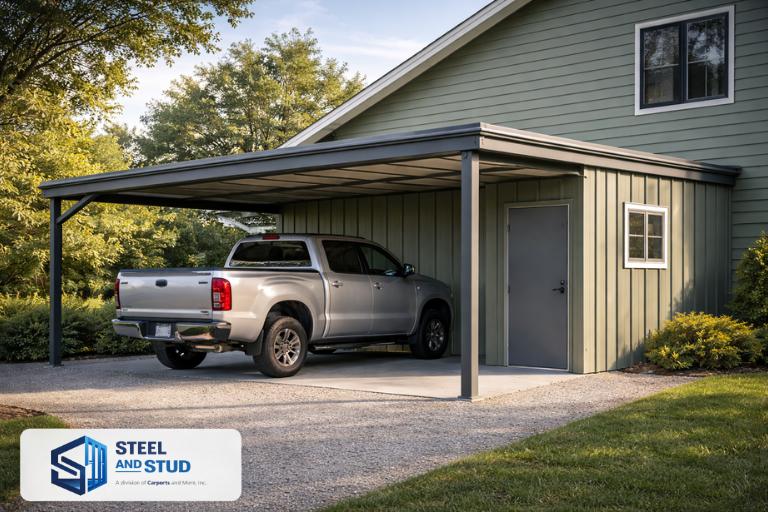
This popular design combines a lean-to carport attached to house with an enclosed storage section along the back wall. The lean-to roof pitch directs water away from your home while the storage area keeps lawn equipment, tools, and seasonal items organized.
A typical configuration uses a 20×30 metal building footprint—enough for one vehicle plus a generous 8-foot-deep storage zone.
3. Rustic Cabin-Style Carport
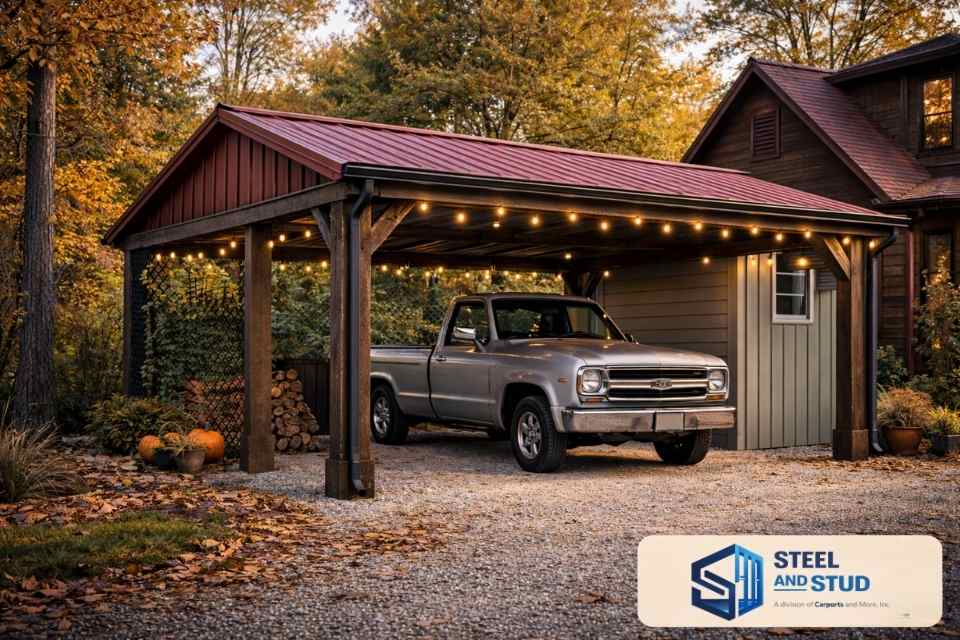
It is another excellent design idea that many homeowners love to embrace. The exterior can be modified as per your tastes. This carport will have a red shingle roof and wooden posts to create a rustic feel on the sides.
There is an electric box set up closer to the structure so that it would be easier for you to convert the carport to a pavilion area. It allows you to use this space for parking vehicles. You can decorate the sides of the carport with lights to keep the space well illuminated for hours together.
4. Barn-Style Attached Carport
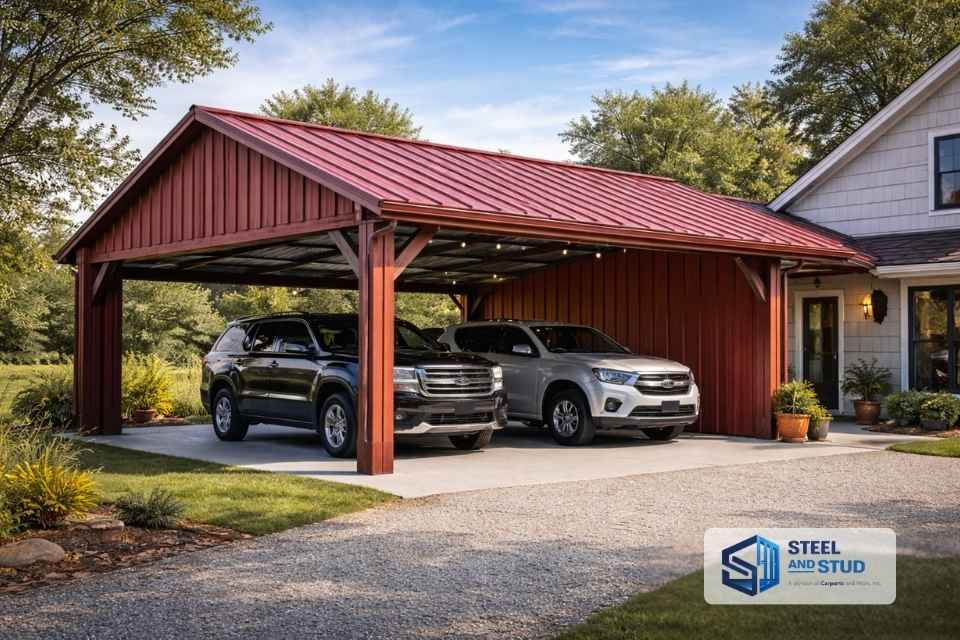
The carport has an enclosed space offering you enough storage. It can house two cars easily with no garage door, so you can directly park the vehicle as soon as you enter your home premises. The tall roof adds enough space inside to store bikes, and you can also set up a car lift.
This carport is attached to the breezeway, making the exterior gel well with the interior space. You can have epoxy floor coating so that it would be easy for you to clean the carport with heavy traffic.
For a similar enclosed feel, explore our 24×36 metal building options.
5. Pergola-Style Carport
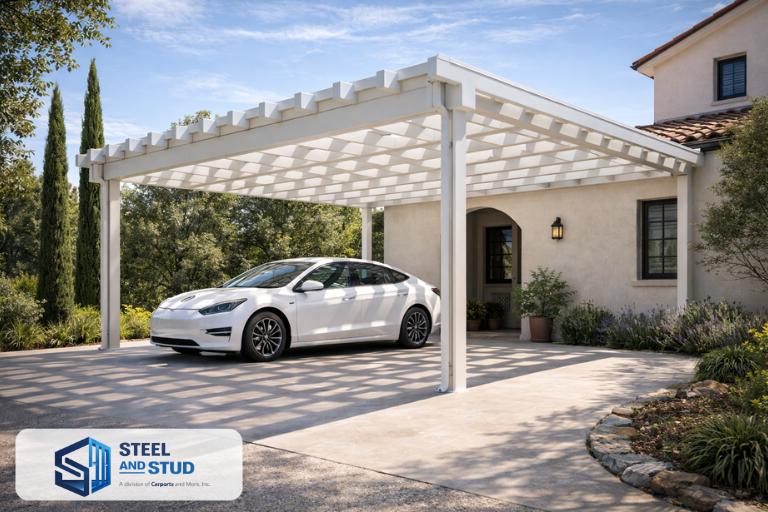
When you are planning carport design, you can take inspiration from a pergola. The structure has thick beams that are spaced evenly to offer a covered unit with a pitched roof. You can install gutters to promote good drainage and let the water drain away from the home without clogging up in one place.
This design is ideal for mild climates where full coverage isn’t critical. The open-beam aesthetic adds curb appeal while still providing meaningful shade and UV protection for your vehicle’s paint.
6. Solar Panel Carport
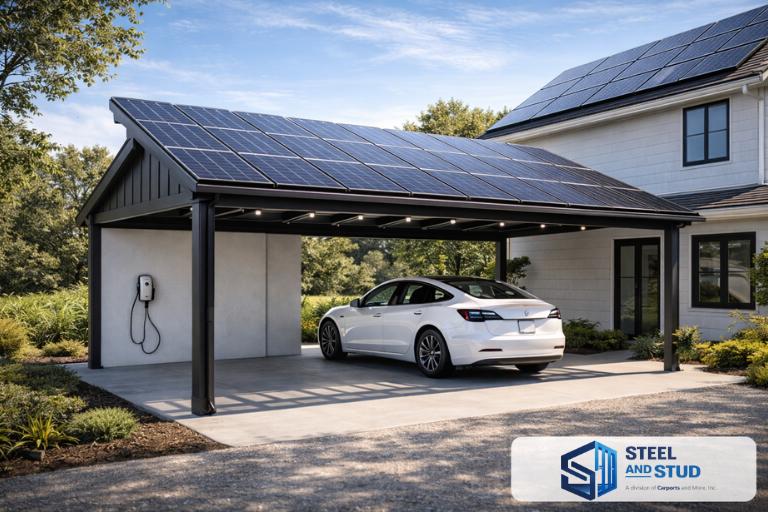
You can make the best use of the additional space in your front yard to build a carport that can offer multiple purposes. The latest design idea is to build the carport with solar panels on the roof, transforming the structure into an energy-generating asset.
In 2026, solar carport installations are surging thanks to expanded federal tax credits. A typical two-car solar carport can generate 3,000–5,000 kWh per year, offsetting a significant portion of your electricity bill—or charging your EV for free. The steel frame provides the structural strength needed to support panel weight and wind loads.
7. Contemporary Wooden Slat Carport
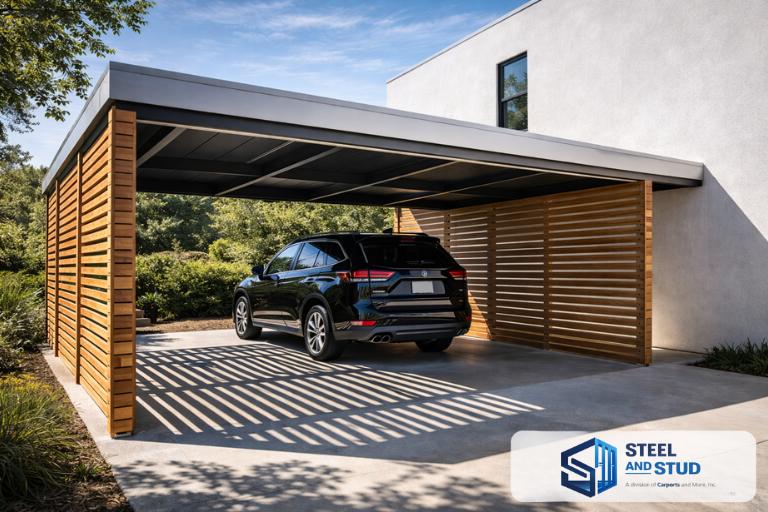
It is a brilliant and unique carport design that makes your parking space appealing and rich. There are wooden slats used horizontally along the structure and joined together with aluminum panels. The sides offer enough privacy and protect your car from different weather conditions and road debris.
You can make the carport an extension of your home while constructing the building. It improves the home’s elegance and gives cohesion throughout the space in your exterior. It adds functionality and gives you a lot of space to park the vehicle.
8. Mediterranean-Style Carport
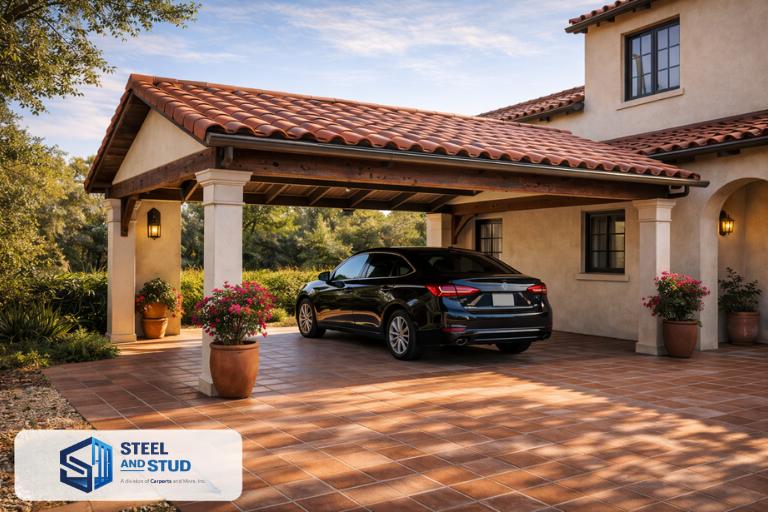
You can make your home stand out from the rest of the homes in your locality by choosing this type of carport design. It is made with red-titled shingles, plaster walls, and rustic wood trims. It is simple and elegant.
Having this brings a rich look to your home exterior. This offers shelter to your cars and a place for your kids to play. Your furry friends can also take shelter when the weather outside is harsh.
9. Craftsman Carport
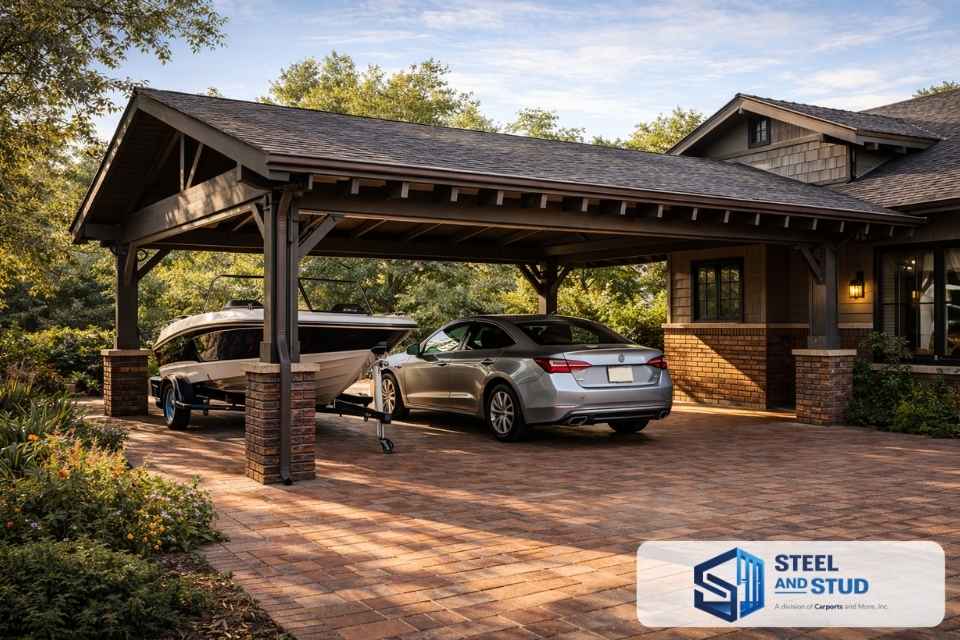
Another amazing carport design idea that you can consider when constructing a new home or planning to remodel the old one. The craftsman carport is constructed with exposed beams and decorative brackets. The heavy overhead beams will emphasize the craftsmanship of the whole unit.
The structure complements the driveway design and has enough space for you to park large boats and RV vehicles that are small and mid-size. The craftsman style makes the carport sturdy and allows it to withstand outdoor weather conditions, dust, and grime.
10. Carport as Home Extension
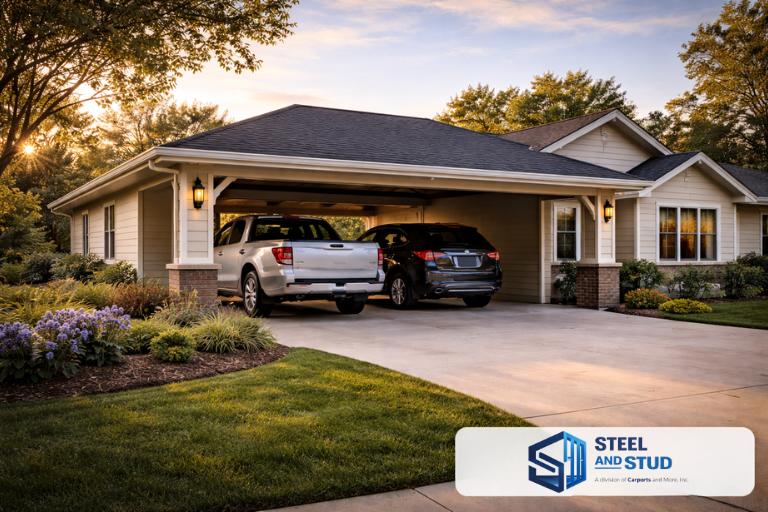
This wonderful carport design is loved by many and brings a rich appeal to the place. It never looks like a carport—instead, it reads as an addition to the home. This area is not just for parking your vehicles but can also be used as a hangout spot during weekends to chill out with friends and family.
It adds aesthetic value to the home and improves its value. The structure lets the architectural elements do the talking without taking away the home design elements. It offers enough balance between function and form, and the front yard’s landscaping remains the focal point.
11. Double Carport with Breezeway
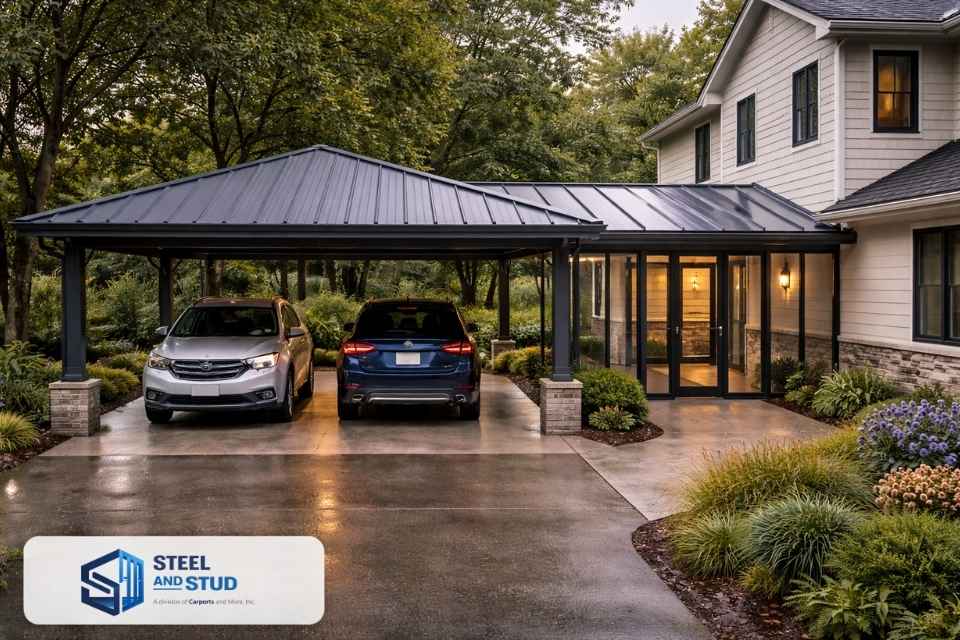
A double carport attached to house with a covered breezeway creates a sheltered walkway between your front door and parking area. This design is perfect for rainy climates—you’ll never get wet walking from car to house.
The breezeway can double as an outdoor entertaining corridor. Size it at 24×24 feet minimum to comfortably fit two vehicles side by side. Check out our 24×32 garage configurations for similar footprint ideas.
12. Aluminum Carport for Mobile Homes
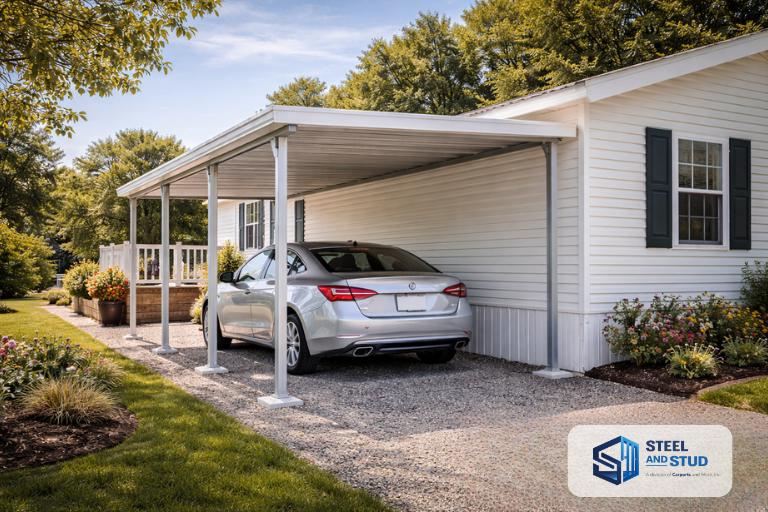
Lightweight aluminum carports for mobile homes are specifically engineered for manufactured housing. These structures use independent footings rather than attaching directly to the mobile home’s walls, which typically aren’t load-bearing.
Aluminum resists corrosion, weighs less than steel, and installs quickly. A standard single-wide mobile home carport measures 12×20 feet and costs between $1,500 and $3,500 installed in 2026. Browse our 12×20 metal building options for sizing guidance.
13. Carport with Enclosed Side Walls
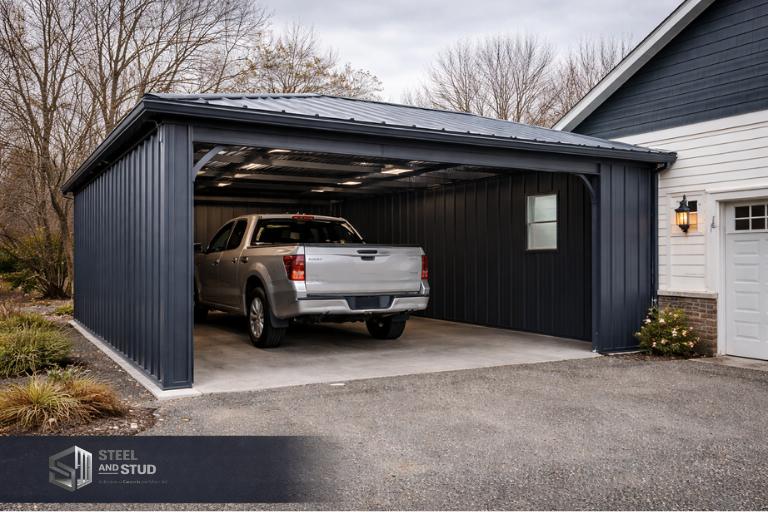
Adding partial or full enclosed side walls to your attached carport gives you extra protection from wind-driven rain, road dust, and prying eyes. You can enclose one, two, or three sides while keeping the entry open for easy vehicle access.
Metal side panels in matching gauge steel create a cohesive look. This design is especially popular in northern states where blowing snow is a concern. It’s also a smart first step if you plan to convert the carport into a full garage later.
14. RV Carport Attached to House
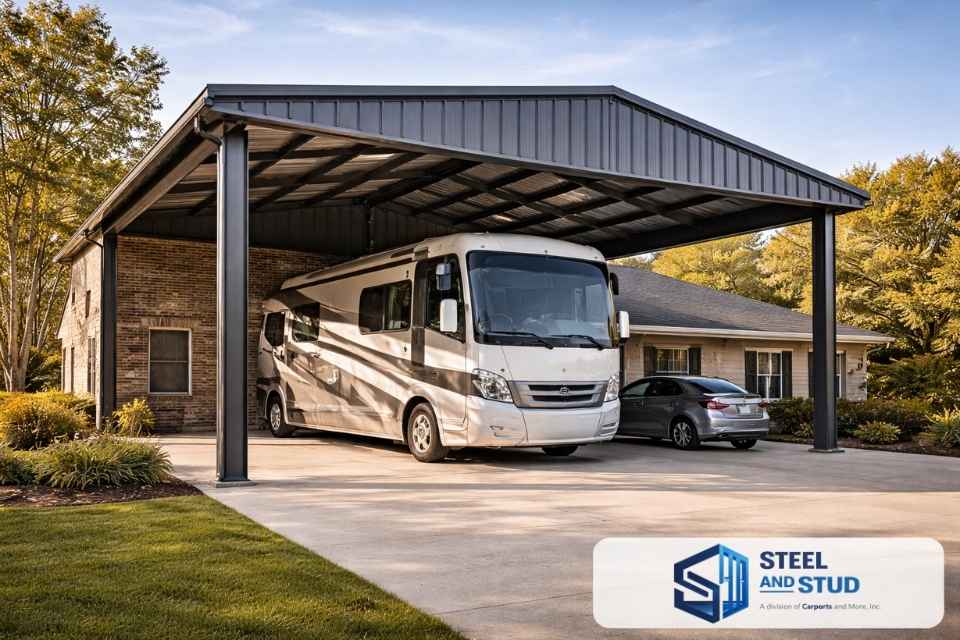
It’s nearly impossible to store RVs in standard garages, so a tall-clearance RV carport attached to house is the solution. These structures require a minimum 14-foot leg height and typically measure 20×30 feet or larger to accommodate Class A and Class C motorhomes.
The cost ranges from $6,000 to $18,000 based on style and material. Heavy-gauge steel framing (12-gauge or 14-gauge) is recommended for the wider spans. Explore our 20×40 metal building sizes for RV-friendly dimensions.
15. Carport-to-Garage Conversion Design
Planning ahead? A carport-to-garage conversion design uses a reinforced steel frame, a concrete slab foundation, and pre-planned wall attachment points so you can easily enclose the structure later. You start with an open carport today and add walls, a garage door, windows, and an entry door when your budget allows.
This phased approach saves money upfront while keeping your options open. Make sure your initial concrete slab is at least 4 inches thick and your frame is rated for the added wind and snow loads of an enclosed building. Our 20×20 metal building is a popular starting size for single-car conversions.
Do Carports Increase or Decrease Property Value?
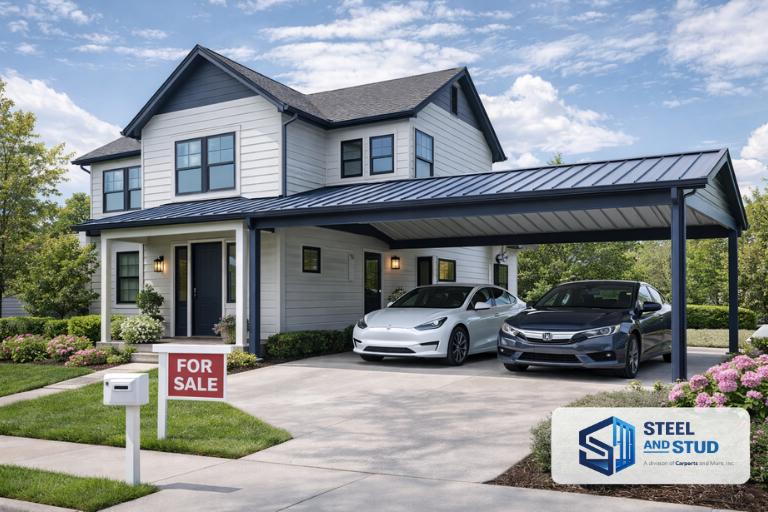
This is one of the most common questions homeowners ask: “Do carports decrease property value?” The short answer is no—when properly designed and permitted, an attached carport typically increases your property value.
Here’s what the data shows:
- A well-built attached carport can add $5,000 to $15,000 in resale value, depending on your market and the quality of construction.
- According to real estate professionals, covered parking is a top-10 buyer priority in most U.S. markets.
- Carports that match the home’s architectural style and use quality materials deliver the strongest ROI—often 50% to 80% of the installation cost.
When carports can hurt value:
- Unpermitted structures that create legal headaches during a sale
- Cheap, flimsy portable canopies that look temporary
- Designs that clash with the home’s style or block windows
- Structures that violate HOA covenants or setback requirements
The takeaway? Invest in a custom metal carport attached to house that complements your home’s design, pull the proper permits, and you’ll enjoy both daily convenience and a solid return when it’s time to sell.
Do Attached Carports Work in Winter?
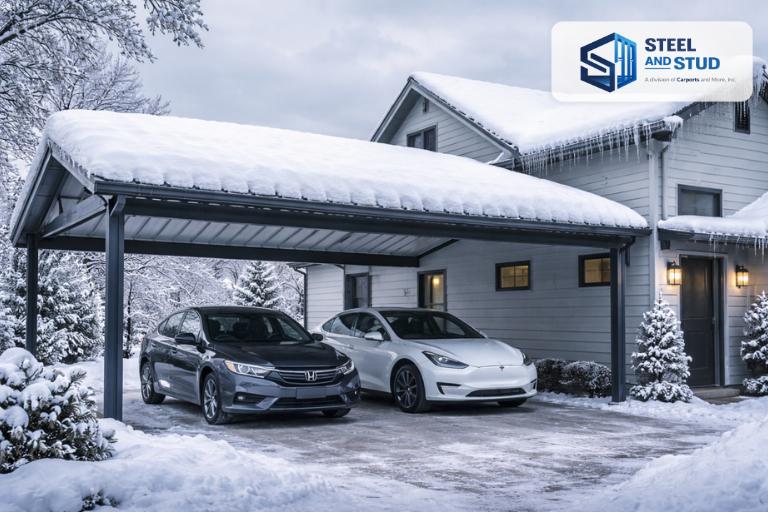
Yes, attached carports absolutely work in winter—and they offer several advantages over leaving vehicles exposed to the elements.
Here’s how an attached metal carport protects you during cold months:
- Snow and ice protection: Your car stays clear of heavy snowfall, reducing morning scraping and brushing time.
- Frost prevention: The roof blocks radiant heat loss, meaning less frost forms on your windshield overnight.
- Hail defense: Metal roofing panels absorb hail impact that would otherwise dent your vehicle.
- Salt and moisture reduction: Covered parking reduces exposure to road salt spray and moisture that accelerates rust.
Snow Load and Wind Ratings
When ordering an attached carport for a snowy climate, pay close attention to snow load ratings and wind speed ratings:
Climate Zone | Recommended Snow Load | Recommended Wind Rating |
Light snow (South, coastal) | 20 PSF | 90–110 MPH |
Moderate snow (Mid-Atlantic, Pacific NW) | 30–40 PSF | 110–130 MPH |
Heavy snow (Northeast, Rockies, Upper Midwest) | 50–65 PSF | 130–150 MPH |
PSF = pounds per square foot.
For heavy snow regions like Minnesota, North Dakota, or Alaska, choose 12-gauge or 14-gauge steel framing with a steeper roof pitch (at least 3:12) to encourage snow shedding. Adding a vertical roof style—where the panels run from ridge to eave—helps snow and ice slide off more efficiently.
An attached carport also benefits from the radiant heat escaping your home’s wall, keeping the covered area a few degrees warmer than a freestanding structure in the same conditions.
Frequently Asked Questions About Attached Carports
A carport attached to a house is most commonly called a lean-to carport, an attached carport, or a carport addition. The term “lean-to” comes from the single-slope roof design that leans against the existing structure. You may also hear it referred to as a carport cover attached to house or simply an attached carport kit if it comes as a pre-engineered package.
In most jurisdictions, yes—you need a building permit for an attached carport. Because the structure connects to your home, it’s typically classified as a building addition and must meet local building codes for structural integrity, setbacks, and fire safety.
Permit requirements vary by city and county. Some areas exempt small freestanding carports under a certain square footage (often under 200 sq ft), but attached structures almost always require a permit. Fees typically range from $75 to $500.
Pro tip: Call your local building department or check their website before you start. Many municipalities now offer online permit applications, making the process faster in 2026 than ever before.
Building an attached carport without a permit can lead to serious consequences:
- Fines and penalties: Your city can issue daily fines until the structure is permitted or removed.
- Forced removal: In worst-case scenarios, you may be ordered to demolish the carport at your own expense.
- Insurance issues: Your homeowner’s insurance may deny claims related to an unpermitted structure.
- Resale problems: When you sell your home, the buyer’s inspector or lender will flag unpermitted additions, potentially killing the deal or requiring costly retroactive permitting.
The permit process protects you. It ensures your attached carport meets wind, snow, and seismic requirements for your area—keeping your family and vehicles safe.
Custom metal carports attached to the house don’t usually require a full poured foundation, but a level site is necessary for a firm hold. Your foundation options include:
- Concrete slab (4-inch): The gold standard. Provides a clean, level parking surface and solid anchor points. Costs $5–$10 per sq ft.
- Concrete footings only: Individual piers at each post location. More affordable at $200–$600 total and works well on gravel or dirt surfaces.
- Auger anchors: Best for bare ground or soft soil. The auger style ensures that the steel carport stands strong and still without concrete.
- Asphalt anchors: Used when installing on an existing asphalt driveway.
- Mobile home anchors: Specialized anchors designed for manufactured housing foundations.
Your local building code will often dictate the minimum foundation requirement. In frost-prone areas, footings must extend below the frost line (typically 36–48 inches deep) to prevent heaving.
Absolutely. This is one of the biggest advantages of choosing a steel-framed attached carport. Converting a carport to a garage typically involves:
- Adding metal or wood-framed side walls and a back wall
- Installing a garage door (single or double)
- Adding windows and an entry door for ventilation and access
- Upgrading electrical for lighting, outlets, and a garage door opener
The key is planning ahead. If you think you might convert later, start with a concrete slab foundation, use heavier-gauge steel framing (14-gauge minimum), and ensure your roof is rated for enclosed-building wind loads. The conversion itself typically costs $3,000 to $10,000 depending on size and finishes.
Explore our 20×40 garage and 18×20 garage options for conversion-ready sizes.
Installation timelines depend on the complexity of your project and whether you’re going DIY or hiring professionals:
Installation Method | Timeline |
DIY with a pre-engineered kit | 1–3 days (with a helper) |
Professional installation (kit) | 4–8 hours |
Custom-built from scratch | 3–7 days |
With new concrete slab | Add 3–5 days for pouring and curing |
Pre-engineered attached carport kits from Steel and Stud come with pre-cut, pre-drilled components that dramatically reduce installation time. Most handy homeowners can complete the assembly over a weekend with one helper and basic tools.
Ready to Add a Metal Carport to Your Home?
Adding a metal carport attached to house is one of the smartest home improvement investments you can make in 2026. You get instant vehicle protection, additional storage space, and a boost to your property value—all at a fraction of the cost of building a full garage.
Whether you’re looking for a simple lean-to carport attached to house, a 2-car carport attached to house, or a custom design for your mobile home, Steel and Stud has you covered.
Here’s how to get started:
- Design your carport using the Steel and Stud carport builder — configure size, style, roof type, and color in minutes.
- Get an instant 2026 quote with no obligation.
- Choose DIY or professional installation — our pre-engineered kits ship with everything you need.
🔧 Start Your Project Today: Design your attached carport now → Get a free, no-obligation quote and see how affordable custom carport protection can be. Our steel building specialists are standing by to answer your questions and help you choose the perfect configuration for your home.
Need a larger structure? Browse our full range of metal building sizes, from a compact 12×24 metal building to a massive 40×60 metal building and everything in between. No matter the size of your project, we deliver nationwide with industry-leading warranties and customer support.